Marketing mix modelling (MMM) is worth it once you run three or more paid channels with meaningful spend and have at least a year, ideally two, of weekly sales and spend data. Below that, lift tests usually answer your questions faster and for less money. MMM’s job is to tell you how to split your budget across channels, and it does that well only when the data gives it enough to work with.
This guide covers what a model actually tells you, how it compares with attribution and lift tests, a five-point readiness check, what makes a model you can trust, and lessons from building them in-house.
What marketing mix modelling actually tells you
A marketing mix model is a statistical model of your sales over time. It looks at weekly sales alongside weekly spend in every channel, plus the things that move sales without any advertising: seasonality, holidays, price changes, promotions and underlying demand. From that, it estimates:
- What each channel contributed to sales, over and above the sales you’d have had anyway
- The return on each channel, so you can compare them on the same footing
- Diminishing returns: the point where extra spend in a channel stops paying back
- A better budget split for the same total spend, and what changes if the budget goes up or down
Because it works from totals, MMM doesn’t need to track individual people. Cookie consent, ad blockers and iPhone privacy settings don’t affect it, which is one reason it has come back into fashion. The two best-known open-source models are Google’s Meridian, generally available since January 2025, and Meta’s Robyn.
MMM, lift tests and attribution compared
Each method answers a different question, and they work best together.
| Attribution | Lift tests | Marketing mix modelling | |
|---|---|---|---|
| Question it answers | Which ads got credit for a sale? | Did this channel or tactic cause extra sales? | How should the budget be split across channels? |
| Data it needs | Click and view tracking | A test group and a control group | One to two years of weekly sales and spend |
| How fast | Daily | A few weeks per test | A few weeks per model, then regular refreshes |
| Main weakness | Over-credits retargeting and brand search; misses what it can’t track | Answers one question at a time | Describes the past; needs good data and spend that varies |
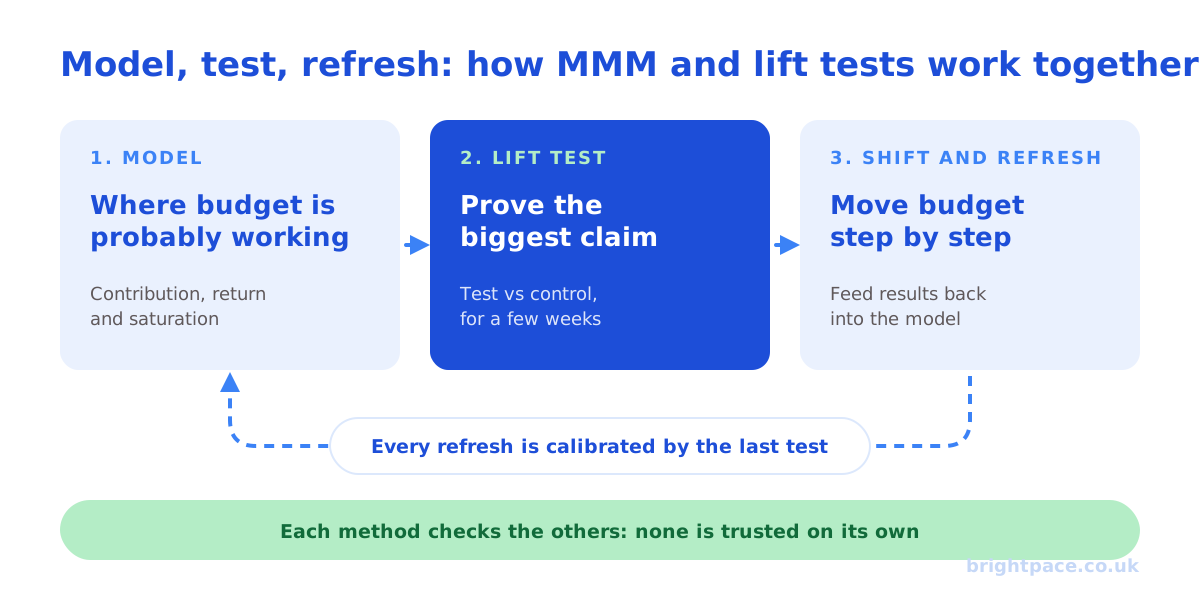
The cycle that works: the model shows where your budget is probably working hardest, a lift test proves the biggest claim, and the lift test result makes the next model more accurate.
Is your business ready? A five-point check
- Three or more paid channels with meaningful spend. With one or two channels, there’s little to split, and lift tests on those channels will tell you more.
- At least a year of weekly data, ideally two. The model needs to see the same season more than once to tell seasonality apart from the effect of advertising.
- Spend that has moved. If a channel’s budget has been flat for two years, the model can’t separate its effect from your baseline sales. Seasonal budget changes, launches and past tests all help.
- Clean, consistent data. Weekly sales, spend by channel, a promotions calendar and any price changes. Gaps, renamed campaigns and missing spend all weaken the model.
- A decision big enough to justify it. Splitting next year’s budget, deciding whether to launch a new channel, or defending spend to a finance team are good reasons. Curiosity alone usually isn’t.
Four or five ticks: a model is worth building. Two or three: fix the gaps and run lift tests first. None or one: start with accurate tracking and blended numbers such as MER.
When lift tests are the better first step
Lift tests beat MMM when:
- Most of your budget is in one or two platforms
- Your question is about one tactic, such as retargeting or brand search
- You need an answer within a few weeks
- You have less than a year of reliable data
Meta and Google both offer built-in lift tests, and geo tests work across channels. Geo tests run your ads in some areas and not others, then compare sales; Google’s free GeoX tool helps plan and read them, though it needs an analyst to run. See our guide to lift tests for how to run one properly.
What makes a model you can trust
A model can fit your past sales beautifully and still be wrong about what caused them. These are the checks that matter most:
- Seasonality and demand first. Before any channel gets credit, the model should account for seasonal patterns, holidays, price changes and underlying demand. Google search interest for your category is a useful guide to demand.
- Brand search treated separately. Brand search mostly collects demand that other channels created. Modelled alongside the rest of Google, it makes Google look like it created sales it only captured.
- Channels grouped by how they really work. Split a platform into too many small pieces and each one has too little signal to estimate.
- Tested on weeks it hasn’t seen. Hold back the most recent weeks, then check the model predicts them well.
- Calibrated with lift tests. Meridian lets you feed experiment results into the model as prior evidence, so the model’s estimates line up with what you’ve proven. Its companion tool, GeoX, turns geo test results into exactly that evidence.
- Sense-checked by people who know the channels. If a result contradicts everything you know about a channel, find out why before acting on it.
Lessons from building models in-house
Our founder has built marketing mix models in-house using Google’s Meridian, for multi-channel businesses with highly seasonal demand. A few lessons that rarely make it into the guides:
- Model the season explicitly. For a seasonal business, a model without a proper seasonal pattern hands advertising the credit for the calendar. This is the single most common way models flatter paid media.
- Always keep a holdout. Every model looks convincing on the data it was trained on. Its predictions for weeks it hasn’t seen are the quickest honesty check.
- Separate brand capture from demand creation in Google. Brand search, and campaigns that mostly serve brand searches (Performance Max often does, unless brand is excluded), behave like demand capture. Keep them apart from non-brand search and control for search interest.
- Don’t split retargeting out of a platform. Modelling Meta prospecting and retargeting as separate channels usually leaves each with too little independent movement to estimate. Model the platform as a whole, and use lift tests to judge retargeting.
- Scale regional models to market size. In a geo-level model, bigger regions naturally produce more sales; without scaling, the model confuses size with advertising effect.
- Budget time for the data. Pulling, cleaning and joining the data usually takes longer than building the model.
Worked example
An illustrative example, not a client result. A mid-sized online retailer spends £60,000 a month across four channels and has two years of weekly data:
| Channel | Monthly spend |
|---|---|
| Meta | £25,000 |
| Google non-brand search | £15,000 |
| YouTube | £12,000 |
| Brand search | £8,000 |
The model finds that about half of sales would have happened anyway (baseline demand). Meta has the strongest return of the paid channels, but its curve is flattening at current spend. YouTube has room to grow. Brand search mostly captures demand the other channels created.
The decision: move £5,000 a month from Meta prospecting to YouTube for a quarter, run a geo lift test on YouTube to confirm the model’s estimate, then refresh the model in six months with the new data. Nothing moves all at once, and the biggest claim gets tested before it drives more budget.
What MMM costs and how long it takes
- Software: open-source models such as Meridian and Robyn are free to use. Commercial MMM platforms charge licence fees on top of the work.
- The work: most of the cost is data preparation, building and validating the model, and turning the results into decisions.
- Time: usually a few weeks from receiving clean data to the first read-out.
- Refreshes: every quarter or half-year, or after a big change in your market or budget.
We build marketing mix models as a fixed-price project, quoted after a short data review that tells you whether a model is worth building yet.
Common mistakes
- Building a model on too little data, then treating its output as fact.
- Letting seasonality masquerade as advertising. If your peak months and your peak spend line up, the model needs help telling them apart.
- Trusting a model that hasn’t been tested on weeks it hasn’t seen.
- Reading the numbers as precise. Model results come with uncertainty; look at the ranges as well as the central estimate.
- Moving the whole budget at once. Shift some, test it, then shift more.
- Never refreshing. A model built two years ago describes a market that has moved on.
FAQs
How much data do I need for marketing mix modelling?
At least a year of weekly sales and spend data, and ideally two, so the model can separate seasonality from advertising. It also needs spend that has varied over time: a channel whose budget never changes can’t be measured.
Can a small business use MMM?
Usually not yet. With one or two channels, or less than a year of data, there isn’t enough signal for a reliable model. Lift tests and accurate tracking will tell you more, faster and for less.
Is Google Meridian free?
Yes. Meridian is open source, so there’s no licence fee. You still need the skills and time to prepare the data, build and validate the model, and interpret the results, which is where the cost of an MMM project sits.
How is MMM different from multi-touch attribution?
Multi-touch attribution follows individual clicks and views to share out credit for each sale, so it misses anything it can’t track. MMM works from total sales and spend over time, without tracking individuals, and answers a different question: how to split the budget across channels.
How often should a marketing mix model be refreshed?
Every three to six months for most businesses, and after any big change in budget, channels, pricing or the market. Each refresh can also take in your latest lift test results.
How do you know when a model needs refreshing to stay accurate?
Check it against the weeks since it was built. If its predictions for recent weeks start missing actual sales by more than they did when you tested it, it’s drifting. Other triggers: you’ve launched or dropped a channel, changed budget a lot, changed prices or your offer, or a lift test result disagrees with what the model says. Any of these is a reason to refresh early rather than wait for the next scheduled update.
In short
Marketing mix modelling earns its keep when you run three or more channels with meaningful spend and have at least a year of weekly data. Below that, lift tests answer your questions faster and for less. When you do build a model, account for seasonality and demand first, treat brand search separately, test it on unseen weeks and calibrate it with lift tests, then move budget step by step and prove the biggest shifts.
Sources
The documentation and coverage this guide is checked against. Last checked October 2026.
- Meridian, Google for Developers
- google/meridian, Google on GitHub
- Introduction to Meridian GeoX, Google for Developers
- Robyn, Meta Open Source on GitHub
- Google releases its open source marketing mix model to all, MarTech
- About Conversion Lift, Google Ads Help
Want to know whether a model is worth building for you? See our marketing mix modelling service, read about measurement and incrementality testing, or let’s chat.
Want a senior eye on your paid media strategy?
Work directly with the founder: no juniors, no hand-offs, 30-day rolling contracts.