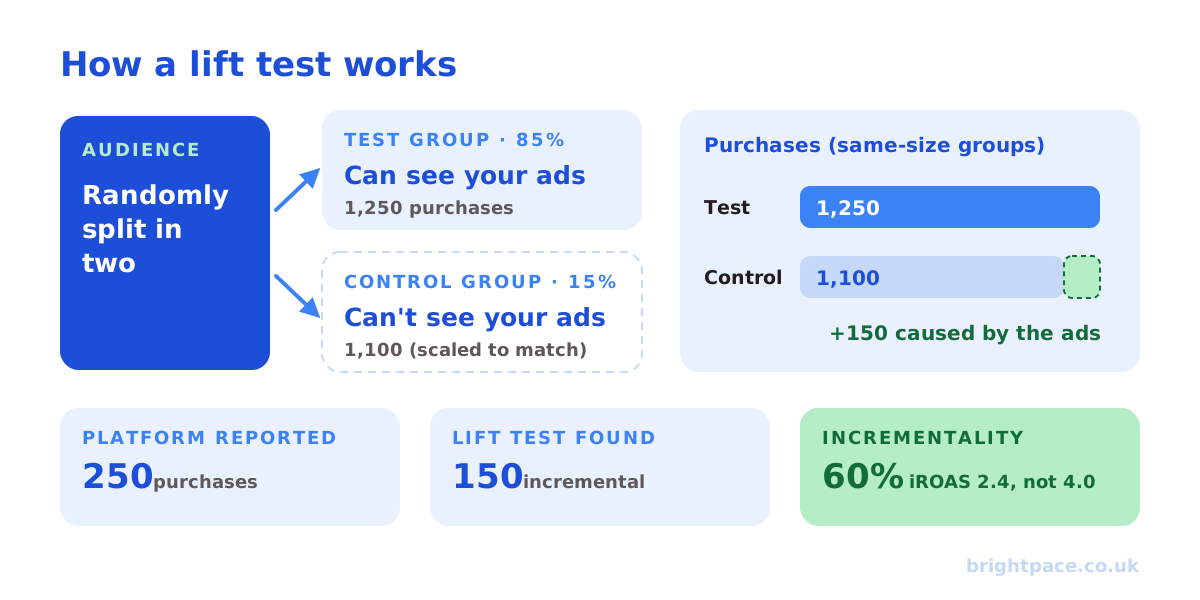
A lift test measures what your advertising actually causes. It splits your audience, people or places, into a test group that can see your ads and a control group that can’t, then compares how many people in each group buy, sign up or enquire. The difference is the incremental result: the sales that wouldn’t have happened without the ads. Every major ad platform now offers some form of lift test, and in October 2026 Google opened user-based Conversion Lift to Search and Performance Max campaigns, so more advertisers can run them without going through a Google rep.
This guide covers which tests each platform offers, how to set one up properly, how to read the results and how to turn them into better budgets and targets.
Why platform numbers aren’t enough
Ad platforms report the conversions that happened after someone saw or clicked an ad. That includes people who would have bought anyway: existing customers, people already searching for your brand, shoppers who were going to come back regardless. Every platform also claims credit for the same sale, so added together they usually report more conversions than you made. Our guide to MER vs ROAS vs POAS shows how far apart those numbers can get.
A lift test answers the question attribution can’t: what would have happened if we hadn’t run these ads? It’s the most reliable way to check whether retargeting, brand search or Performance Max is genuinely adding sales, and therefore where the next pound should go.
The main types of lift test
- User-based conversion lift: the platform randomly holds back a share of your target audience from seeing your ads, then compares conversions between the two groups. Precise, but only measures that platform’s ads.
- Geo-based lift (geo experiments): regions are split into test and control areas, and ads run only in the test areas. It works for any channel, including TV, programmatic and new channels, and doesn’t depend on tracking individual users, but needs more volume. Free tools such as Google’s GeoX and Meta’s GeoLift help plan and read geo tests, though both need an analyst to run.
- Holdout or pause tests: a simpler version: switch a campaign off in some regions, or for a set period, and compare against a matched baseline. Less precise, but possible on almost any budget.
- A/B experiments: compare two versions of a campaign, such as two bidding strategies. Useful, but they tell you which version is better, not whether the ads are incremental at all.
- Brand lift: surveys people in exposed and unexposed groups about awareness or consideration. Good for awareness campaigns; it doesn’t measure sales. See the top 5 awareness channels and how to measure them.
Which platforms offer what
At the time of writing (October 2026): availability, eligibility and minimum spend vary by account, so check each platform’s experiments section or ask your account team:
| Platform | Lift testing available | Worth knowing |
|---|---|---|
| Google Ads | User-based Conversion Lift for Search and Performance Max (newly self-serve), plus Display, Video, Demand Gen and App; geo-based studies; campaign experiments for A/B tests; Google’s free open-source GeoX for geo tests | Eligibility varies by account; some campaign types still need a Google rep |
| Meta | Conversion Lift and A/B tests in Experiments; Meta’s free open-source GeoLift for geo tests | Lift studies usually need meaningful conversion volume; some accounts need a Meta rep |
| TikTok | Conversion Lift Study | Run with TikTok’s team, with minimum spend depending on the objective |
| Conversion lift and brand lift tests | Useful for proving B2B impact; check availability in Campaign Manager | |
| Microsoft Advertising | Performance Max “uplift” experiments (beta) comparing exposed and suppressed users over six weeks or more; A/B experiments for Search | Uplift testing is still in beta |
| Any channel | Geo holdout or pause tests | Works for programmatic, ChatGPT ads, TV and anything else |
How to set up a lift test properly
- Start with one decision. Write down the question and what you’ll do with each answer: for example, “Is our Meta retargeting adding sales? If incrementality is below 40%, we’ll cut its budget in half.” Tests without a decision attached rarely change anything.
- Measure the outcome that matters. Use purchases, qualified leads or revenue, ideally from your own systems through server-side tracking, the Meta Conversions API or offline conversions, not clicks or add-to-baskets.
- Make sure it can give a clear answer. Small tests produce wide, inconclusive results. Estimate how many conversions you’ll get, decide the smallest lift worth detecting, and check the numbers with our sample size calculator. If you won’t have enough conversions, test a bigger slice of spend, run longer or switch to a geo test.
- Choose the holdout size. A bigger control group gives a more precise answer but means more people don’t see your ads, which can cost sales during the test. A 10–20% holdout is common for user-based tests; geo tests often split regions more evenly.
- Run it long enough. Two to six weeks is typical, plus time for late conversions to come in: longer for considered purchases and B2B sales cycles. Microsoft’s uplift experiments ask for six weeks or more.
- Keep everything else steady. Avoid big budget, bidding or creative changes during the test, and avoid peaks like Black Friday unless peak performance is what you’re testing.
- Don’t stop early. Results swing in the first days. Decide the end date in advance and read the result then.
How to read the results
Most lift reports show four numbers:
- Incremental conversions: conversions in the test group minus what the control group predicts would have happened anyway.
- Lift %: incremental conversions as a share of that baseline.
- Incremental CPA and incremental ROAS (iROAS): your spend divided by incremental conversions, or incremental revenue divided by spend. These are the numbers to plan budgets with.
- Confidence: how sure the platform is that the lift is real. A result that isn’t statistically significant doesn’t prove the ads did nothing; it means the test couldn’t tell.
The most useful comparison is incremental results against what the platform reported for the same period. That ratio, sometimes called the incrementality factor, tells you how much of the platform’s reported performance is real.
Worked example
An online retailer tests Meta retargeting for four weeks with a 15% holdout. The figures are illustrative:
- Spend: £5,000. Average order value: £80.
- Ads Manager reported: 250 purchases, a cost per purchase of £20 and ROAS of 4.0.
- The test group made 1,250 purchases; the control group, scaled to the same size, made 1,100.
- Incremental purchases: 1,250 − 1,100 = 150, so 150 ÷ 250 = 60% of what Meta reported was genuinely caused by the ads.
- Incremental CPA: £5,000 ÷ 150 = £33.33, not £20.
- Incremental ROAS: (150 × £80) ÷ £5,000 = 2.4, not 4.0.
Retargeting is still adding sales, but at a much higher true cost than Ads Manager suggests. Whether it’s worth it depends on margin: at a 40% gross margin, break-even ROAS is 2.5, so this retargeting is roughly break-even, not the star performer it appears to be.
How to apply what you learn
- Calibrate your targets. Divide your break-even ROAS by the incrementality factor to get the platform-reported ROAS you actually need. In the example: 2.5 ÷ 0.6 ≈ 4.2 in Ads Manager just to break even. Check yours with our ROAS calculator and incrementality calculator.
- Move budget to what’s genuinely incremental. Compare channels on incremental CPA or iROAS, not platform-reported numbers, and shift spend accordingly.
- Fix what the test exposes. Low incrementality in retargeting often means too much frequency or too many existing customers: tighten audiences and exclude recent buyers. In Performance Max, it often means brand searches: consider brand exclusions; see Performance Max vs Shopping.
- Use attribution settings that fit. Meta’s incremental attribution setting can bring day-to-day reporting closer to what lift tests show.
- Judge the whole on MER. Keep checking total revenue against total spend with our MER and POAS calculator: a lift test calibrates the parts; MER keeps the whole honest.
- Feed it into a mix model. If you run several channels, lift test results can calibrate a marketing mix model, which then shows where the next test should go. See is marketing mix modelling worth it?
- Test again. Results change as budgets, creative and seasons change. Re-test your biggest channels once or twice a year, and test one thing at a time so you know what caused the change.
Common mistakes
- Testing without enough conversions: the result comes back “inconclusive” and the time is wasted.
- Changing the campaign mid-test: new budgets, bids or creative make the result impossible to interpret.
- Reading an inconclusive result as “no effect”: it may simply mean the test was too small.
- Treating one test as permanent truth: incrementality shifts over time and by season.
- Measuring the wrong outcome: a lift in clicks or add-to-baskets isn’t a lift in profit.
FAQs
What is a lift test in advertising?
A lift test compares people (or regions) who can see your ads with a similar group who can’t, to measure how many extra sales, sign-ups or leads the ads genuinely caused. It answers what would have happened without the advertising, which attribution reports can’t.
How long should a lift test run?
Usually two to six weeks, plus enough time for delayed conversions to arrive. Longer sales cycles, such as B2B, need longer tests. Decide the end date in advance and don’t stop early when results look good or bad.
How much budget do I need for a lift test?
Enough to generate a meaningful number of conversions in both groups. Platforms set their own minimums for formal studies, and these vary by account. If you’re below them, a geo holdout or pause test is a cheaper alternative.
What is incremental ROAS?
Incremental ROAS (iROAS) is the revenue your ads genuinely caused, divided by what you spent. It’s usually lower than platform-reported ROAS, because it excludes sales that would have happened anyway.
What’s the difference between a lift test and an A/B test?
An A/B test compares two versions of your advertising to see which performs better. A lift test compares advertising with no advertising, to see whether the ads add anything at all. Both are useful; they answer different questions.
Can Google Ads run lift tests on Search and Performance Max?
Yes. In October 2026, Google opened user-based Conversion Lift studies to Search and Performance Max campaigns as a self-serve option, alongside Display, Video, Demand Gen and App. Availability varies by account, and some campaign types still need a Google representative.
In short
A lift test measures what your ads really add by comparing a group that can see them with one that can’t. Pick one decision to inform, make sure the test is big enough to give a clear answer, keep everything else steady, then compare incremental results with what the platform reported. Use the gap to set honest targets, move budget to what’s genuinely incremental and re-test as things change.
Sources
The platform documentation and coverage this guide is checked against. Last checked October 2026.
- About Conversion Lift, Google Ads Help
- About A/B testing, Meta Business Help Centre
- About incremental attribution, Meta Business Help Centre
- GeoLift: open-source geo experiment methodology, Meta Open Source on GitHub
- Introduction to Meridian GeoX, Google for Developers
Want your advertising judged on what it genuinely adds? We design, size and read out tests as an incrementality testing agency, as part of our wider measurement work. Or let’s chat.
Want a senior eye on your paid media strategy?
Work directly with the founder: no juniors, no hand-offs, 30-day rolling contracts.