Black Friday 2026 falls on Friday 27 November 2026, with Cyber Monday on Monday 30 November. For UK eCommerce brands it’s no longer one day; it’s a season that starts weeks earlier and runs into December. The brands that win it don’t just spend more that week: they fix the foundations, build audiences and test creative now, and they protect profit while everyone else chases revenue.
Here’s the paid media plan we’d follow from today to Christmas.
Black Friday 2026: the key dates
- Black Friday: Friday 27 November 2026
- Cyber Monday: Monday 30 November 2026
- Black Friday week: roughly Monday 23 to Monday 30 November
- Christmas delivery cut-offs: typically mid-December, depending on your carriers, plan your final push around them
Why the run-up matters
Paid media gets more competitive as peak approaches. More advertisers enter the auction, costs rise, and the algorithms have less time to learn. Everything you can do before November, clean tracking, a healthy feed, warm audiences, tested creative, is something you won’t be paying peak prices to figure out.
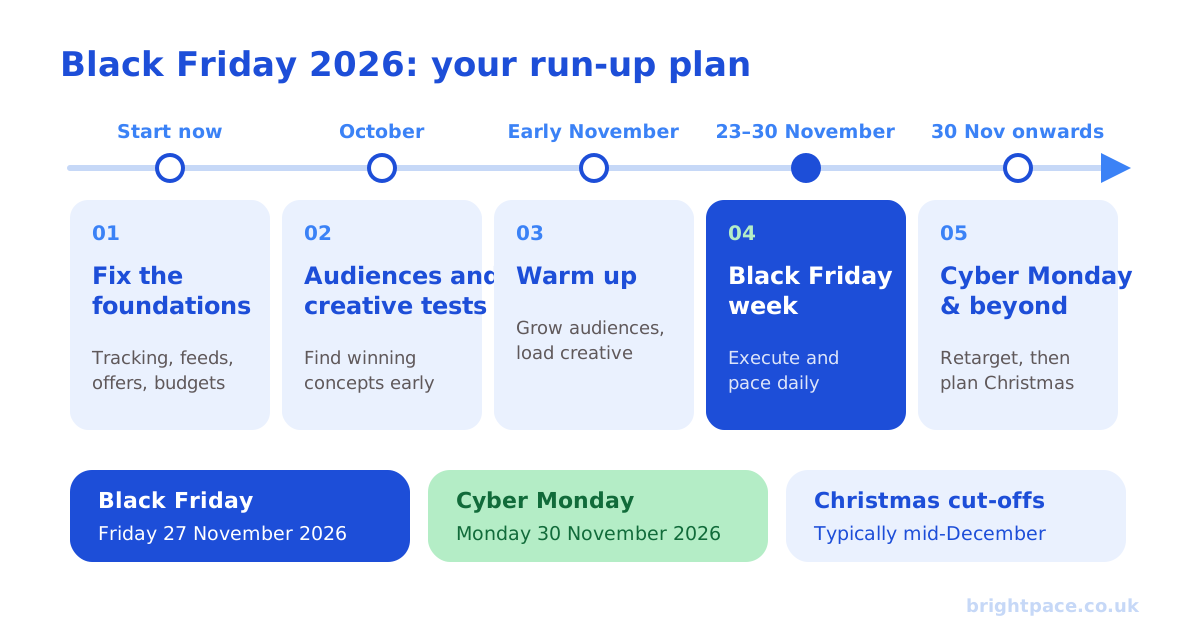
Start now: fix the foundations
Start here. It’s the work that makes every peak pound go further:
- Tracking you can trust. Check purchase tracking fires once with the right value, and that the Meta Conversions API and Google Enhanced Conversions are in place. Peak is the worst time to discover you’ve been under-reporting sales.
- A healthy product feed. Fix disapprovals, strengthen titles and attributes, and add custom labels for margin and bestsellers so you can bid on profit, not just revenue.
- Site speed and checkout. Peak traffic magnifies every point of friction. Test your checkout on mobile.
- Stock and margin by product. Know which products you can discount deeply and which you can’t: before the creative is made.
Short on time? A paid media audit now gives you an independent, prioritised fix list while there’s still time to act on it.
October: build audiences and test creative
This is where most brands under-invest, and where the biggest Black Friday wins are set up:
- Prospect before prices peak. Build awareness and engaged audiences while costs are lower, so you have people to retarget when the offer lands.
- Grow your owned lists. Early-access sign-ups and email/SMS subscribers are the cheapest Black Friday customers you’ll ever get.
- Test creative now, not in November. Run a disciplined creative-testing framework so you go into peak with proven winners, not guesses.
Early November: warm up
- Tease the offer. Early-access and waitlist campaigns turn October’s audiences into buyers-in-waiting.
- Set up promotions early. Google Merchant Center promotions and sale-price annotations can take time to approve: don’t leave them to the week itself.
- Plan budgets by day. Map spend across the whole of Black Friday week, not just the Friday, and track it with our budget pacing calculator.
Black Friday week: execute
- Brief the algorithms. Google Ads seasonality adjustments tell Smart Bidding to expect a short, sharp conversion-rate spike: useful for events of a few days, like Black Friday week, that automated bidding can’t predict from history alone.
- Lead with your best-margin offers. Structure Shopping and Performance Max so budget favours the products that stay profitable at their discounted price.
- Retarget hard, prospect smart. Meta Advantage+ catalogue ads (formerly dynamic product ads) re-engage viewers with the exact products they browsed; keep prospecting focused on your warmed audiences.
- Watch pacing daily. Costs per click and CPMs move fast. Check your CPM and CPA against target and move budget to what’s converting profitably.
Cyber Monday and beyond
Black Friday is the start of the season, not the end:
- Cyber Monday often behaves like a second peak: keep budgets and creative ready.
- Exclude recent purchasers from prospecting and switch them to cross-sell and gifting messages.
- Pivot to Christmas gifting around your delivery cut-offs, then prepare for Boxing Day and January sales: our Christmas and January sales plan covers each phase.
Protect profit: the discount maths
This is where most Black Friday campaigns quietly lose money. A discount doesn’t just lower revenue: it raises the ROAS you need just to break even.
Take a product that sells for £100 and costs you £50: a 50% margin, so your break-even ROAS is 2.0x:
- At 20% off, it sells for £80 and makes £30: a 37.5% margin. Break-even ROAS rises to 2.67x.
- At 30% off, it sells for £70 and makes £20: a 28.6% margin. Break-even ROAS rises to 3.5x.
Keep the same ROAS target you use the rest of the year, and deeply discounted products can lose money on every sale while the dashboard looks great. Set offer-specific targets instead: work yours out with our ROAS calculator, and read what a good ROAS actually is.
Measure what actually happened
Platform dashboards all claim credit for the same Black Friday sale. Judge peak on business numbers:
- Blended revenue and profit across all channels, not each platform’s reported ROAS
- New customers acquired: and their likely lifetime value, which is often the real prize of Black Friday
- Contribution after ad spend, by offer, so next year’s discount strategy is based on evidence
Your Black Friday 2026 checklist
- Audit tracking, feed and checkout now: ideally by mid-October
- Map margin and discount depth by product
- Build audiences and owned lists through October
- Test creative before November, not during it
- Set up Merchant Center promotions early
- Plan budgets across the whole week, with seasonality adjustments for the peak days
- Set offer-specific ROAS targets from your discounted margins
- Exclude purchasers and pivot to gifting after Cyber Monday
- Review on blended profit and new customers
FAQs
When is Black Friday 2026?
Black Friday 2026 is on Friday 27 November, with Cyber Monday on 30 November. Most of the work, though, happens in the weeks before.
When should I start planning Black Friday ads?
Now. Fix tracking and your product feed first, build audiences and test creative through October, then warm up in early November so campaigns are ready to scale in Black Friday week.
How do I stop Black Friday discounts eating my profit?
Set targets from your discounted margins, not your normal ones. A 25% discount can wipe out much of the profit on an order, so the ROAS you need to break even rises sharply.
In short
Black Friday 2026 is won in the weeks before 27 November, not on the day. Fix your tracking and feed now, build audiences and test creative through October, and set targets from your discounted margins, so peak season grows profit, not just revenue.
Sources
The platform documentation and coverage this guide is checked against. Last checked October 2026.
- About seasonality adjustments, Google Ads Help
- Tips for optimising your average daily budget, Google Ads Help
- About Customer Match, Google Ads Help
Planning your peak season? See how we run eCommerce paid media, book a paid media audit while there’s still time to act on it, or let’s chat.
Want a senior eye on your eCommerce advertising?
Work directly with the founder: no juniors, no hand-offs, 30-day rolling contracts.