There is no universal “good” ROAS. A good return on ad spend is any figure above your break-even ROAS, which is set by your profit margin. A business on 25% margins needs a far higher ROAS to make money than one on 70% margins, so a “4x” that’s great for one brand loses money for another.
This guide shows you how to calculate your break-even ROAS, set targets for profit or growth, factor in repeat customers, and avoid the measurement traps that make ROAS look better than it is. Prefer to skip the maths? Use our free ROAS calculator.
What is ROAS?
ROAS (return on ad spend) = revenue from ads ÷ ad spend. If you spend £1,000 and it drives £4,000 in revenue, your ROAS is 4.0, often written as 4x or 400%.
ROAS measures revenue, not profit. That’s the root of most confusion: a campaign can have a high ROAS and still lose money once you account for the cost of the products you sold.
First, calculate your break-even ROAS
Break-even ROAS is the point where ad-driven revenue exactly covers your product costs and your ad spend. The formula is simple:
Break-even ROAS = 1 ÷ gross margin
| Gross margin | Break-even ROAS |
|---|---|
| 20% | 5.0x |
| 25% | 4.0x |
| 40% | 2.5x |
| 50% | 2.0x |
| 70% | 1.43x |
Below that number, every sale loses money. Above it, you profit. This single figure matters more than any benchmark you’ll read online.
A worked example
Say you spend £10,000 on ads and they drive £40,000 in revenue: a 4.0x ROAS.
- At a 30% margin, that revenue generates £12,000 of gross profit. Take off the £10,000 of ad spend and you’ve made £2,000.
- At a 20% margin, the same revenue generates £8,000 of gross profit. After ad spend, you’ve lost £2,000.
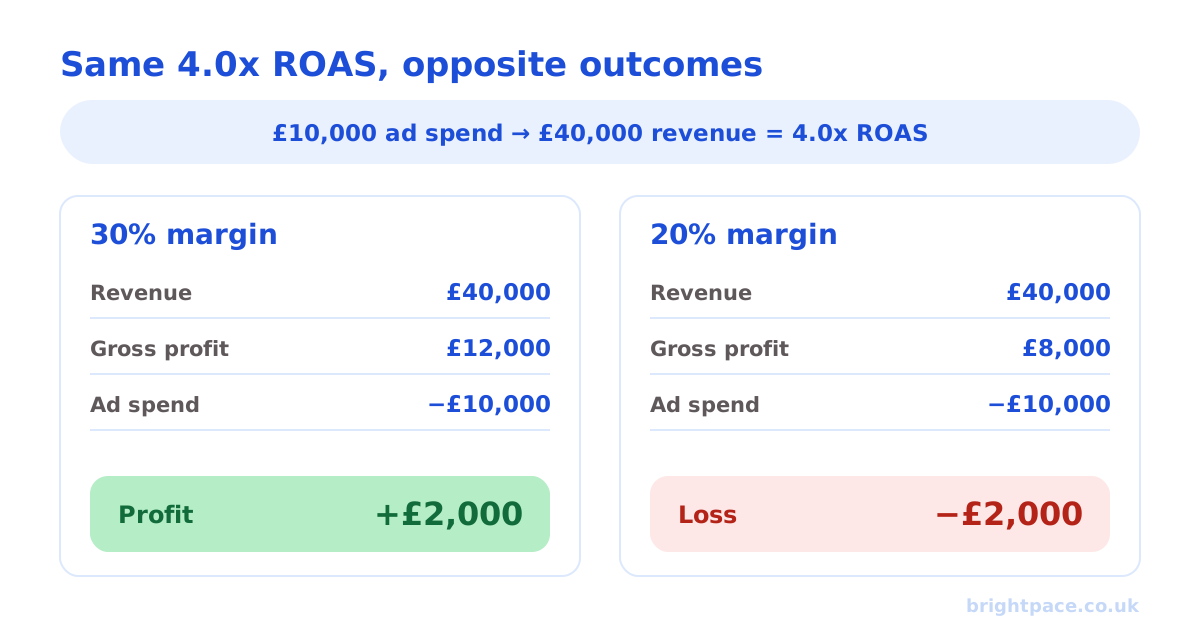
Same ROAS, same dashboard: completely different business outcome.
Use contribution margin, not just gross margin
Gross margin often flatters the picture. For a more honest break-even, use your contribution margin: what’s left after the variable costs of each sale:
- Product cost
- Shipping and fulfilment
- Payment processing fees
- Returns and refunds (a big one in fashion and footwear)
If those costs take a 50% gross margin down to a 35% contribution margin, your real break-even ROAS rises from 2.0x to about 2.86x.
Then set a target ROAS above break-even
Your target depends on what you want ad spend to do:
- Maximise profit → set target ROAS well above break-even and accept lower volume
- Maximise growth → set target closer to break-even to buy more volume, as long as each sale still contributes
- Acquire customers you’ll keep → you can go below first-purchase break-even if lifetime value justifies it (see below)
Efficiency and volume pull against each other. Push for a higher ROAS and you’ll usually get less of it; chase volume and ROAS falls. The right answer is a deliberate business decision, not whatever the bid strategy happens to produce: the principle behind commercial alignment over channel metrics.
Don’t optimise to first-purchase ROAS if you have repeat customers
This is the most common expensive mistake. If customers buy again, judging ads on the first order alone will make you under-invest in exactly the customers who are worth most.
If a customer is worth £300 over their lifetime, not £60 on order one, your acceptable acquisition cost, and therefore your ROAS target, changes completely.
This is especially true in eCommerce and subscription/SaaS models, where the second and third purchases are where the profit lives. Check your unit economics with our LTV:CAC calculator.
Set targets by product and offer, not account-wide
One blended target hides a lot:
- Segment by margin. High-margin products can run at a lower ROAS than low-margin ones. Group them separately so they aren’t averaged together.
- Adjust for discounts. A discount raises your break-even ROAS: 20% off a 50%-margin product pushes break-even from 2.0x to 2.67x. It’s why peak-season promotions need their own targets; see our Black Friday 2026 plan.
- Separate brand from non-brand. Brand searches convert cheaply and inflate blended ROAS. Judge prospecting on its own numbers.
ROAS vs ROI, POAS and blended ROAS
- ROI measures profit against total investment: the true bottom line, but slower and harder to calculate per campaign.
- POAS (profit on ad spend) replaces revenue with gross profit: POAS = gross profit ÷ ad spend. A POAS above 1.0 means ads are profitable.
- Blended ROAS (or MER) divides total revenue by total marketing spend across all channels: a useful reality check against any single platform’s figures.
For when to use each one, see MER vs ROAS vs POAS.
Why platform-reported ROAS can mislead
The ROAS in Google Ads or Meta Ads Manager is a useful steering signal, but not the full truth:
- Double counting. Google and Meta can both claim the same sale.
- Attribution windows. Different click and view windows give different answers.
- Demand you’d have got anyway. Brand searches and returning customers make ROAS look better than the incremental value ads actually add.
Use platform ROAS to steer day to day, and blended revenue and profit to judge whether ad spend is really working.
Feed the platform the right goal
Once you know your targets, make sure the ad platforms optimise toward them:
- Use Target ROAS or value-based bidding rather than optimising to clicks or raw conversions: see our Performance Max best practices
- Pass accurate conversion values, ideally margin-aware, and, where possible, true or offline revenue
- Segment products by margin so high-margin lines aren’t averaged with low-margin ones
Getting this measurement right is exactly what a Google Ads audit tends to uncover first.
Running Google Shopping? See how to set ROAS targets by margin in our guide to Google Shopping for Shopify stores.
Frequently asked questions
Is a 4x ROAS good?
Only if your margin supports it. A 4x ROAS is exactly break-even at a 25% margin, comfortably profitable at 50%, and loss-making at 20%. Work out your own break-even first.
What is a good ROAS for Google Ads?
There’s no single number that applies across businesses. Your break-even ROAS, set by your margin and variable costs, is the benchmark that matters, then set a target above it based on whether you’re prioritising profit or growth.
Should my ROAS target be the same on every campaign?
Usually not. Brand, prospecting, high-margin and low-margin products, and discounted offers all have different economics, so they deserve different targets.
In short
Stop asking “what’s a good ROAS?” and start with “what’s my break-even ROAS?” Calculate it from your contribution margin, set targets above it by product and goal, factor in lifetime value if customers repeat, and judge results on blended profit rather than platform dashboards. A profit-aware target beats a vanity benchmark every time.
Sources
The platform documentation and coverage this guide is checked against. Last checked October 2026.
- About Target ROAS bidding, Google Ads Help
- About the ROAS goal, Meta Business Help Centre
Want targets built around your margins and lifetime value, not a generic benchmark? That’s the commercial thinking behind our media management, or start with a paid media audit. Let’s chat.
Want a senior eye on your paid media strategy?
Work directly with the founder: no juniors, no hand-offs, 30-day rolling contracts.