On this page
- Concepts first, iterations second
- Test one variable at a time
- Structure tests so the platform doesn’t decide for you
- Read the right metrics at each stage
- Give tests enough signal to be real
- Scale the learning, not just the ad
- Build a testing cadence
- Keep a creative learning log
- Common creative testing mistakes
- FAQs
- In short
- Sources
Creative testing means running different versions of your ads against each other to learn which ideas, hooks and formats bring in customers, and why. A creative testing framework makes that a repeatable process, so each test builds on the last instead of starting from scratch. Most testing fails because it’s really just guessing with a bigger budget: lots of ads, no structure, no learning. A framework turns creative from a cost into a compounding advantage.
It matters more than ever. On Meta and TikTok, the algorithms now lean on creative to decide who sees your ads; we explain why in Meta Andromeda: creative is the new targeting. If creative is doing the targeting, testing it well is doing your targeting well.
Concepts first, iterations second
There are two very different kinds of creative test, and mixing them up wastes budget:
- Concept tests compare genuinely different ideas: a different angle, audience motivation or story. “Save time” versus “save money” versus “look good in front of your boss”. These find new pockets of demand.
- Iteration tests refine a proven concept: a new hook, a shorter cut, a different thumbnail or opening line. These squeeze more out of what already works.
Most accounts over-iterate: dozens of near-identical variations of one idea. Start by finding the concepts that work, then iterate on the winners.
Test one variable at a time
Within an iteration test, if you change the hook, the format and the offer all at once and it wins, you’ve learned nothing transferable, because you don’t know why it won. Isolate the variable:
- Hook: the first three seconds of a video, or the headline of a static
- Format: creator-style versus polished, static versus video, carousel versus single image, aspect ratio (check each one with our safe zone checker)
- Message / angle: the core benefit or pain you lead with
- Messenger: founder, customer, creator or no face at all
- Offer: what you’re actually promising, and at what price
A clean test tells you why something worked, which is the only thing you can reuse.
Structure tests so the platform doesn’t decide for you
Put five new ads in one ad set and the platform will usually push most of the spend to one or two of them within days. That’s efficient for delivery, but it isn’t a fair test, because some ads never get enough impressions to be judged.
Options, from most to least controlled:
- Platform A/B test tools: Meta’s Experiments and TikTok’s split testing divide audiences so each version gets a fair share.
- A dedicated testing campaign or ad set with a fixed budget, where new concepts run before graduating to your main campaigns.
- Adding new ads into live campaigns and reading early signals. It’s the fastest option but the least rigorous, so treat results as directional.
Many brands ring-fence a fixed share of spend for testing so it doesn’t get cut the moment performance tightens. The right share depends on budget and how quickly your creative fatigues.
Read the right metrics at each stage
Different metrics tell you different things. Read them as a chain, from attention through to outcome:
| Stage | What to look at | What it tells you |
|---|---|---|
| Attention | Hook rate (3-second views ÷ impressions), thumb-stop | Did the opening earn attention? |
| Engagement | Hold rate, average watch time, click-through rate | Did the story keep people and make them act? |
| Conversion | Conversion rate, cost per acquisition, ROAS | Did it drive the outcome you pay for? |
A high hook rate with poor conversion points to a strong opening and a weak offer or landing page. Poor hook rate with strong conversion from those who do watch suggests a good idea with a weak first three seconds, so iterate the hook. Final decisions should rest on the commercial metric, with CTR as supporting evidence.
Give tests enough signal to be real
A creative “winner” from 30 conversions is noise. Before you crown anything:
- Work out how many visitors you need before you start with our A/B test sample size calculator
- Let it gather enough conversions to be meaningful, and check significance with our A/B test calculator
- Don’t stop the moment it crosses the line: repeatedly peeking inflates false positives
- Run across full weeks so weekday and weekend behaviour are both included
- If volumes are low, test bigger differences (whole concepts rather than tweaks) so any gap is large enough to detect
Scale the learning, not just the ad
This is the step almost everyone skips. The real value of a winning creative is the insight behind it. If “lead with the price guarantee” wins, that’s a message insight you can apply to:
- The next round of creative, in new formats and with new messengers
- Your other channels: search ad copy, display, email (a principle from one unified media plan)
- Landing pages, product pages and offers
Feed the insight forward and each test makes the next one smarter.
Build a testing cadence
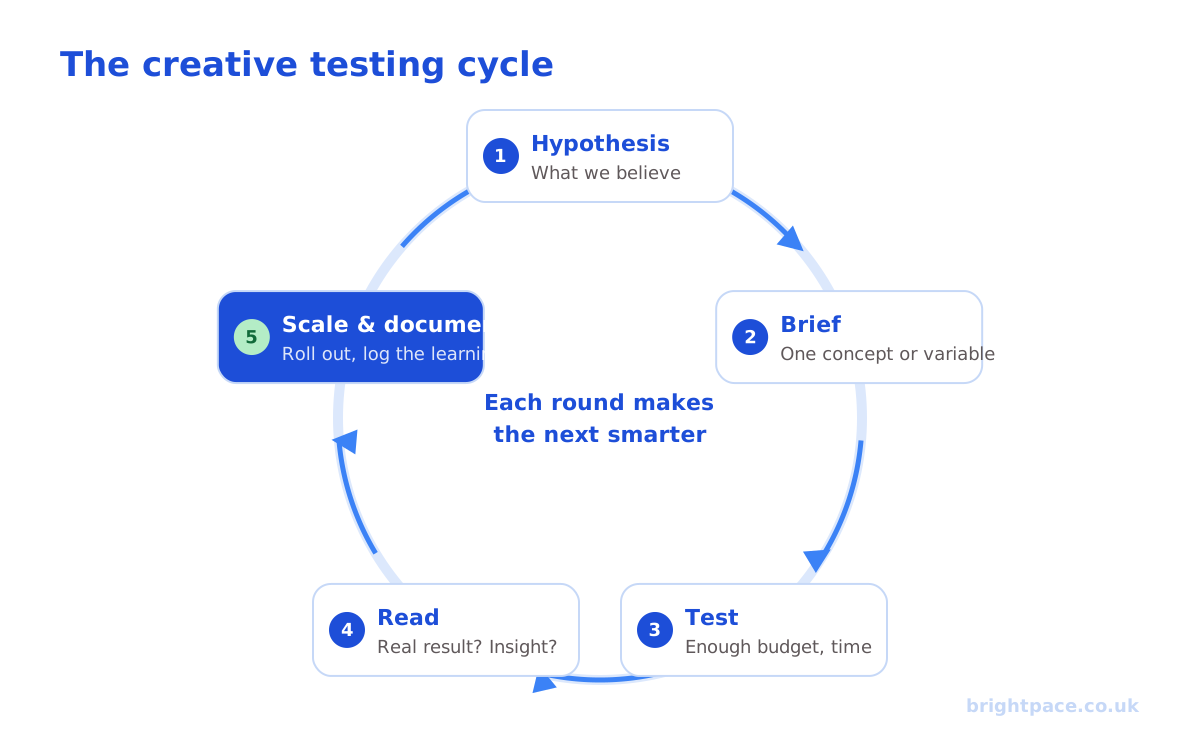
Creative fatigue is real: even winners decay as the same people see them repeatedly. Watch for rising frequency, falling hook rate and climbing costs on your best ads. Run a steady cadence rather than sporadic bursts:
- Hypothesis: what do we believe, about whom, and why?
- Brief: one concept or one variable, with a clear success metric
- Test: enough budget and time for a fair read
- Read: is it significant? What’s the insight?
- Scale and document: roll the winner out, log the learning, brief the next round
Keep a creative learning log
The documentation matters. A shared log of what you’ve learned about your audience is a genuine competitive advantage, and it survives team changes. For each test, record:
- The hypothesis and the variable tested
- The creative, with a link or thumbnail
- Spend, key metrics and whether the result was significant
- The insight in one sentence: “customers respond to proof over promises”
- What you’ll test next because of it
Review the log quarterly. Patterns across tests are often more valuable than any single winner.
Common creative testing mistakes
- Testing ten versions of one idea instead of three genuinely different ideas
- Changing several variables at once, then guessing at what worked
- Calling winners from a handful of conversions
- Judging on CTR or engagement when the goal is sales
- Letting the platform starve new ads of spend and calling them losers
- Never writing anything down, so the same tests get re-run a year later
FAQs
What is creative testing?
Creative testing is running different versions of your ads against each other to find which ideas, hooks, formats and offers bring in customers, and why they work. Done with a framework, each round of tests builds on what the last one taught you.
How many ads should I test at once?
Fewer than most people think. For a fair read, test a handful of genuinely different concepts, or one variable at a time on a proven concept. Put too many ads in one ad set and the platform pushes the spend to one or two of them before the rest are judged.
How long should a creative test run?
Long enough to reach enough conversions for a clear result, usually at least a week so every day of the week is covered. Meta’s A/B testing tool lets you schedule a test for up to 30 days. Don’t stop a test the moment one ad pulls ahead.
Which metrics show a winning ad?
Use hook rate and click-through rate to diagnose what’s happening early, and cost per sale or lead, or return on ad spend, to decide the winner. An ad that earns attention but doesn’t convert hasn’t won.
Should I use Meta’s A/B test tool or test inside a campaign?
Use Meta’s A/B test tool (or TikTok’s split testing) when you need a clean answer, because it gives each version a fair share of the audience. Adding new ads to a live campaign is faster but less rigorous, so treat those results as directional.
In short
Find the concepts that work, then iterate on them one variable at a time. Structure tests so each version gets a fair read, judge them on commercial outcomes with enough data to be real, and scale the insight, not just the asset. Do that on a steady cadence, with a log your whole team can learn from, and creative testing stops being expensive guesswork and becomes your biggest source of edge. The same principles apply on TikTok: see TikTok Smart+ best practices.
Sources
The platform documentation and coverage this guide is checked against. Last checked October 2026.
- About A/B testing, Meta Business Help Centre
- Best practices for A/B tests, Meta Business Help Centre
- Meta Andromeda: supercharging Advantage+ automation with the next-gen personalised ads retrieval engine, Engineering at Meta
Creative fatigue eating your results? We can run your paid social with a structured testing programme, or pressure-test your current process with a paid audit. Let’s chat.
Want a senior eye on your paid social?
Work directly with the founder: no juniors, no hand-offs, 30-day rolling contracts.