On this page
A unified media plan is a single strategy that governs all your paid channels together, shared goals, shared audience thinking and one budget logic, rather than each platform running to its own siloed plan. When channels are managed in isolation they compete for credit and budget; unified, they compound.
This guide covers what goes wrong with silos, how to give each channel a clear role, how to measure across channels, how to allocate budget, and how to run a unified plan week to week.
The problem with channel silos
Run search, social and programmatic as separate fiefdoms and you get predictable dysfunction:
- Double-counting: every channel claims the same conversions, so the numbers add up to more than 100% of reality
- Budget by org chart: spend is split by who owns what, not by where the opportunity is
- Conflicting messages: a prospect sees three different stories in a week
- Competing for the same people: retargeting in three platforms, each bidding for the same warm visitors
- No view of the journey: nobody owns how the channels work together to move someone from unaware to bought
What a unified plan aligns
Bring the channels under one roof and align the things that should be shared:
- Goals and measurement: one definition of success, judged on commercial outcomes, not per-platform ROAS
- Audience strategy: a shared view of who you’re targeting at each stage, so channels hand off rather than collide
- Creative frameworks: consistent messaging, adapted (not copied) for each platform, with learnings from creative testing shared across all of them
- Budget logic: one roadmap that flexes spend toward what’s working
Give every channel a clear role
Channels overlap when nobody has decided what each one is for. Agree roles up front: for example:
| Channel | Typical role | Judge it on |
|---|---|---|
| Paid social (Meta, TikTok) | Create demand with creative, reach new audiences | New customers, blended CAC, incremental lift |
| Programmatic and video | Scaled reach and awareness, including CTV and audio | Reach, brand search uplift, assisted conversions |
| Non-brand search | Capture people actively looking for what you sell | Cost per acquisition or ROAS against target |
| Brand search | Protect your name when people search for you | Incremental value versus organic clicks |
| Retargeting | Convert warm visitors who haven’t bought yet | Incremental conversions, frequency |
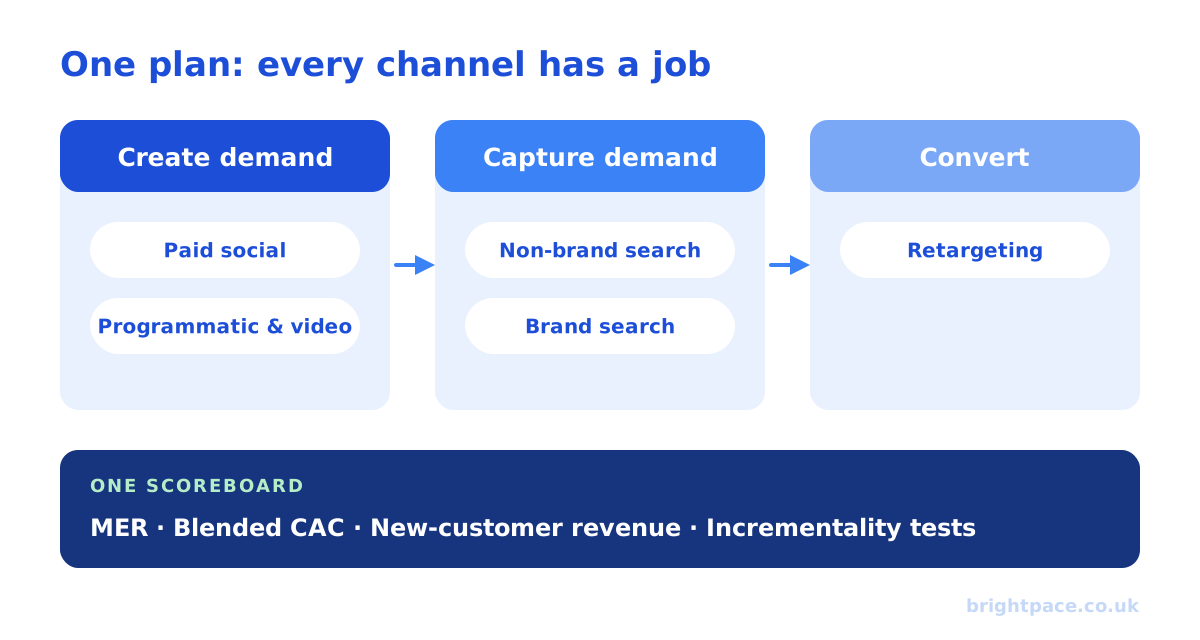
The right mix depends on your business: a B2B plan leans on LinkedIn and search, an eCommerce plan on Shopping and paid social. The point is that every channel has a job, and is judged on that job rather than on last-click conversions alone.
Measure across channels, not within them
A unified plan needs a unified scoreboard. Platform dashboards stay useful for optimisation, but decisions should rest on numbers that don’t double-count:
- Marketing efficiency ratio (MER): total revenue ÷ total marketing spend, across every channel
- Blended CAC: total acquisition spend ÷ total new customers
- New-customer revenue: separated from repeat purchases, so you can see whether you’re actually growing
- Incrementality tests: holdouts, conversion lift studies or geo tests to check what each channel really adds
When platform-reported numbers rise but blended numbers don’t, you’ve found double-counting, not growth.
Allocate budget in three layers
A simple structure keeps budget disciplined but flexible:
- Core: the proven campaigns that reliably hit target. Most of the budget sits here.
- Growth: scaling channels and campaigns that are performing but not yet at full potential.
- Test: new channels, audiences, formats and creative concepts, ring-fenced so they don’t get cut the first week things tighten.
The exact split depends on your stage: a young brand still searching for what works needs more in test; a mature one with proven channels can run more in core. Review the split quarterly.
Let budget follow opportunity, not habit
The biggest win from unifying is budget flexibility. When there’s one plan, you can move spend to where it’s most efficient this week: scaling a channel that’s beating its ROAS target and pulling back one that’s falling short. Siloed budgets can’t do that; they defend their line item.
Pair this with disciplined budget pacing so the flexibility doesn’t turn into overspend.
Run it on a weekly rhythm
A unified plan lives or dies on its operating rhythm. A simple weekly review:
- Blended results: MER, new customers and pipeline against target
- Channel performance: each channel against its role, not just its ROAS
- Budget moves: what shifts this week, and why
- Tests: what launched, what concluded, what we learned
- Creative: which insights should travel to other channels
- Next actions: owners and deadlines
Monthly, step back: are channel roles still right? Is the core/growth/test split still right? Quarterly, revisit targets against margins and plans.
How to move toward it
You don’t need a big-bang reorganisation:
- Start with one shared dashboard and one blended set of KPIs
- Agree channel roles (prospecting, capture, retargeting, brand) so they stop overlapping
- Review budget together, weekly, and move it deliberately
- Treat creative learnings as shared assets, not channel property
- Where different people or agencies run different channels, give one person ownership of the overall plan
FAQs
What is a unified media plan?
One plan for all paid channels, with a clear role for each channel, shared targets and one budget, instead of separate plans that compete for credit.
How should budget be split across channels?
In three layers: a core of proven channels, a growth layer for channels with room to scale, and a small test budget for new ideas, moved weekly as results come in.
How do you measure channels that all claim the same sales?
Measure across channels rather than within them: blended results such as total revenue, new customers and MER, backed by lift tests, instead of adding up each platform’s reported conversions.
In short
Silos make channels compete; a unified plan makes them compound. Give every channel a clear role, measure across channels rather than within them, allocate budget in core, growth and test layers, and run the whole plan on one weekly rhythm, so spend follows opportunity rather than the org chart.
Sources
The platform documentation and tools behind the cross-channel measurement points. Last checked October 2026.
- About data-driven attribution, Google Ads Help
- About attribution models and attribution settings, Meta Business Help Centre
- About Conversion Lift, Google Ads Help
- Meridian marketing mix model, Google for Developers
Running channels that don’t talk to each other? Unifying them is exactly what our media management does: across paid search, paid social and programmatic. Let’s chat.
Want a senior eye on your programmatic?
Work directly with the founder: no juniors, no hand-offs, 30-day rolling contracts.