Meta Andromeda is the machine-learning system Meta uses to decide which ads are even considered for each person on Facebook and Instagram. Announced in December 2024, it narrows tens of millions of eligible ads down to a few thousand candidates before any ranking or auction happens. The practical consequence for advertisers is simple and significant: your creative now does much of the targeting work your audience settings used to do.
Here’s what Andromeda is, what changed, and how to build Meta campaigns that work with it rather than against it.
What is Meta Andromeda?
Meta Andromeda is Meta’s ad retrieval engine: the first stage of its ad delivery system. Every time someone opens Facebook or Instagram, Meta has to pick a handful of ads from an enormous pool. It does that in stages:
- Retrieval: Andromeda selects a few thousand relevant candidates from tens of millions of eligible ads.
- Ranking: more detailed models score those candidates for the individual person.
- Auction: the winning ad is chosen, balancing your bid with its predicted value to the user.
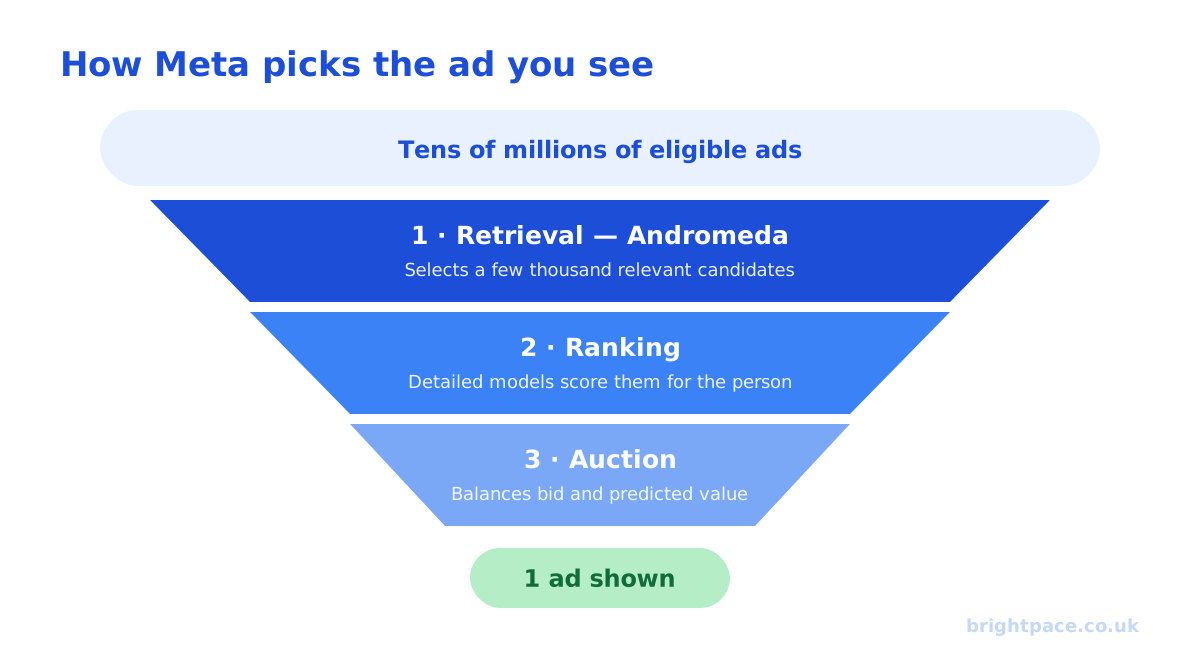
If your ad isn’t retrieved, it never reaches ranking or the auction. That’s why retrieval matters so much, and why the signals Andromeda reads from your ad matter too.
When Meta announced Andromeda, it reported a +6% improvement in recall for the retrieval system and a +8% improvement in ads quality on selected segments, running on NVIDIA Grace Hopper Superchips and Meta’s own MTIA chips. In plain terms: a much bigger, more capable model deciding which ads each person could see.
What changed for advertisers
Andromeda doesn’t change the buttons in Ads Manager: it changes what works. Three shifts stand out:
- Creative became a targeting signal. The system reads your ads, the visuals, message, format and who’s in them, to infer who they’re relevant to. Different creative reaches different people.
- Broad targeting got stronger. With a more capable retrieval model, narrow interest stacks and heavily segmented ad sets usually restrict the system more than they help it. Meta itself recommends broad targeting and Advantage+ placements for most advertisers.
- Variety became fuel. A single ad, or several near-identical versions of it, gives the system very little to work with. Genuinely different creatives give it more ways to match your brand to more people.
Why creative is now your targeting
In the old model, you told Meta who to target and hoped your ad resonated. Under Andromeda, it works the other way round: the ad itself signals who it’s for, and the system finds the people most likely to respond.
A video of a busy parent unboxing your product, a static ad comparing your price to a competitor’s, and a founder explaining why you built the product will each find different audiences, even inside the same broad ad set. That’s the real meaning of “creative is targeting”. Your creative mix is your audience strategy.
What “creative diversification” actually means
This is where most advertisers go wrong. Diversification isn’t more versions of the same ad: it’s more different ads. Meta’s own guidance calls for ads with “different themes, messages, and visuals”.
| Not real diversification | Real diversification |
|---|---|
| Changing the button colour | A different angle: price, quality, speed, status, problem solved |
| Swapping one headline | A different persona: who the ad is clearly for |
| Re-cropping the same video | A different format: static, short video, carousel, catalogue |
| Five near-identical edits | A different messenger: founder, customer, creator, expert |
| New text on the same image | A different proof point: reviews, demos, comparisons, results |
Near-identical variations tend to be treated as near-identical, so they rarely unlock new people. Ten genuinely different concepts will usually do more than fifty small tweaks of one.
How to structure Meta campaigns for Andromeda
Structure should make it easy for the system to learn, not fragment its data:
- Consolidate. Fewer campaigns and ad sets, each with enough budget and conversions to exit learning and optimise properly.
- Go broad by default. Let creative do the targeting. Keep exclusions where they matter commercially: for example, existing customers in an acquisition campaign.
- Use Advantage+ where it fits. Advantage+ sales campaigns and placements give the system room to find your buyers; Advantage+ catalogue ads (formerly dynamic product ads) do the same for eCommerce product feeds: see our eCommerce approach.
- Feed it clean data. Andromeda can only optimise to what it can see. The Meta Conversions API and accurate conversion values are non-negotiable.
A simple creative framework
You don’t need a film studio. You need a system. A practical starting point:
- Pick three or four angles your customers genuinely care about: the problem you solve, the outcome, the proof, the price.
- Make each angle in two or three formats: a static, a short vertical video and a carousel or catalogue ad. Check vertical versions with our safe zone checker.
- Vary the messenger: product-only, founder, real customer or creator.
- Launch in batches, give each batch time to learn, and keep the winners running while you test the next batch.
That’s quickly a dozen genuinely distinct ads: far more useful to Andromeda than a dozen versions of one. Our full creative-testing framework covers how to read results and scale what works.
How to measure creative under Andromeda
- Judge on business outcomes. Cost per acquisition, ROAS against your break-even, and new customers, not click-through rate. Check targets with our CPA calculator and ROAS calculator.
- Look at concepts, not just ads. Group results by angle and format to learn which ideas work, so the next batch is smarter.
- Watch for fatigue. Rising frequency and falling results mean it’s time for new concepts, not new button colours.
- Remember the platform grades its own homework. Meta’s reported conversions are a steering signal; your real revenue is the scoreboard: the principle behind commercial alignment over channel metrics.
Common mistakes
- Splitting budget across many narrow audiences that Andromeda would find better on its own
- Launching lots of near-identical ads and calling it diversification
- Turning ads off after a day or two, before the system has learned
- Judging creative on CTR or CPM instead of profitable conversions
- Neglecting tracking, so the system optimises on incomplete data
FAQs
Does interest targeting still work after Andromeda?
You can still use it, but for most advertisers broad targeting performs as well or better, because the creative now does much of the targeting. With Advantage+ audience, interests act as suggestions rather than hard limits.
How many ads should I run in an ad set?
Enough genuinely different concepts to give the system real choices, often a handful to a dozen, rather than dozens of near-identical variations. Quality of difference matters more than quantity.
Does Andromeda affect small advertisers?
Yes: it decides which ads are considered for everyone. Small budgets benefit most from consolidation: fewer ad sets, each with enough budget and conversions to learn.
How often should I refresh Meta creative?
When the signs of fatigue appear: rising frequency and cost per result, falling conversion rate. Many accounts add a new batch of concepts every few weeks, while keeping proven winners running.
In short
Meta Andromeda is the retrieval engine that decides which ads are even in the running. It rewards broad, consolidated structures and, above all, genuinely diverse creative, because your creative now signals who your ad is for. Make different ideas, not different versions; give the system clean data; and judge results on profit, not platform metrics.
Sources
The platform documentation and coverage this guide is checked against. Last checked October 2026.
- Meta Andromeda: supercharging Advantage+ automation with the next-gen personalised ads retrieval engine, Engineering at Meta
- About A/B testing, Meta Business Help Centre
Want Meta working as hard as your creative? See how we run Meta ads and paid social, book a paid media audit of your Meta account, or let’s chat.
Want a senior eye on your paid social?
Work directly with the founder: no juniors, no hand-offs, 30-day rolling contracts.