For UK retailers, the weeks after Black Friday are really five short seasons: December gifting, a last-orders rush before your delivery cut-off, late gifts that can’t be posted, the Boxing Day and January sales, and a new-year period when costs fall and intent shifts. Christmas Day 2026 is a Friday, so Boxing Day falls on Saturday 26 December, with the bank holiday on Monday 28 December. Each phase needs different messages, budgets and targets, and the brands that plan the switches in advance stop paying for clicks they can’t fulfil.
Here’s the plan we’d follow from Cyber Monday to the end of January.
Christmas and January 2026: the key dates
- Cyber Monday: Monday 30 November 2026, the start of the gifting run, following Black Friday
- Last Saturday before Christmas: 19 December 2026
- Delivery cut-offs: Royal Mail usually recommends posting 2nd class around 18 December and Special Delivery around 23 December, check its official dates and your own carriers once they’re published
- Christmas Day: Friday 25 December 2026
- Boxing Day: Saturday 26 December, with the bank holiday on Monday 28 December
- New Year’s Day: Friday 1 January 2027
- January payday: for many people, Friday 29 January 2027
Why Christmas needs its own plan
Running one “Q4” campaign from November to January wastes money in two ways. Before your cut-off, it under-delivers on the busiest gifting days because budgets and messages haven’t changed. After your cut-off, it keeps paying for clicks from people who want a present by Christmas and won’t order once they see your delivery dates. Splitting the season into phases, and deciding the switches before December, fixes both.
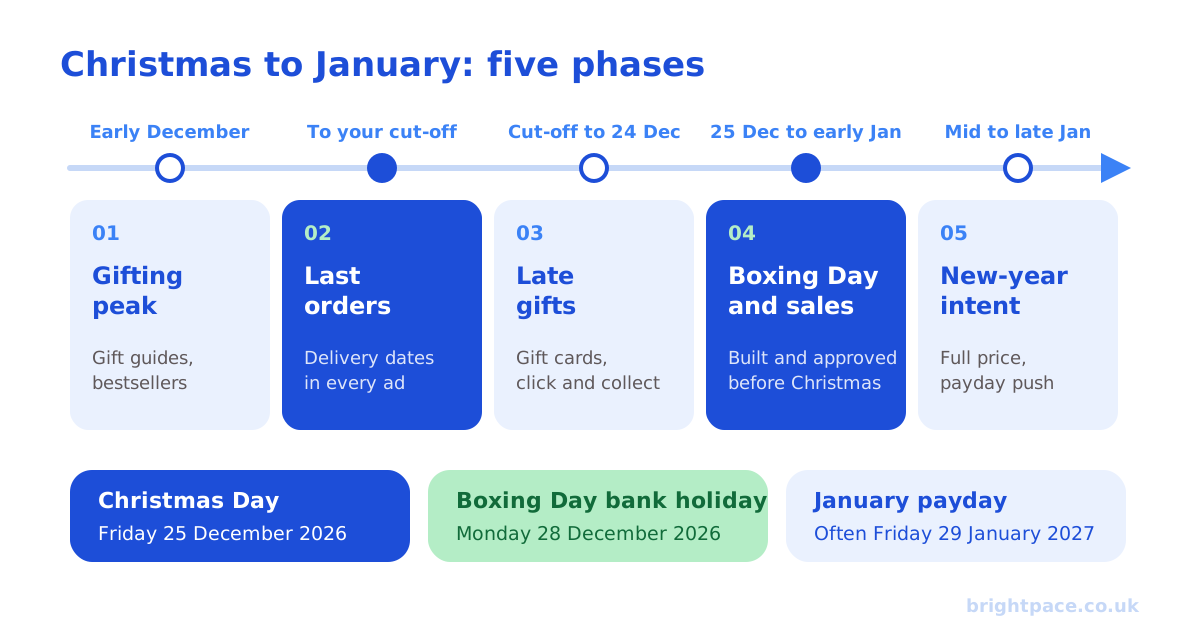
Early December: the gifting peak
After Cyber Monday, people switch from deal-hunting to finding the right present. Your ads should switch with them:
- Lead with gifting, not discounts. Gift guides, “for him / for her / under £50” collections and bestsellers convert better than another sale message, and protect margin.
- Feed your bestsellers. Use custom labels in Merchant Center for bestsellers, margin and stock, so Shopping and Performance Max budget goes to products you can fulfil profitably. See Performance Max vs Shopping for how to structure them.
- Retarget Black Friday browsers. People who viewed products in November but didn’t buy are often still shopping: Meta Advantage+ catalogue ads show them the exact products they looked at.
- Exclude recent buyers from prospecting and show them “complete the gift” or add-on products instead. Our guide to first-party data explains how.
Mid-December: last orders before your cut-off
The days before your last delivery date are often the busiest of the season, and urgency does the selling:
- Put your delivery deadline in the ads. “Order by 18 December for Christmas delivery” in headlines, sitelinks and Meta primary text. Update it as each carrier deadline passes.
- Keep shipping times accurate in Merchant Center, so Shopping ads show realistic delivery dates, and turn on express options if you offer them.
- Pace budget up, not flat. Conversion rates usually rise as the deadline approaches. Plan spend by day and track it with our budget pacing calculator.
- Use seasonality adjustments sparingly. In Google Ads, they tell Smart Bidding to expect a short spike in conversion rate. They work best for events of a few days: your final ordering window, not the whole month.
After the cut-off: late gifts
Once standard delivery can’t make it, most product ads should step back. What should keep running:
- Gift cards and e-gift cards: instant delivery, no stock risk and a reason to visit in January.
- Click and collect or local stock, if you have shops: promoted to people nearby.
- Express delivery, while it’s still guaranteed, with the cut-off time clear in the ad.
- Everything else, paused or cut back. Reduce budgets on products that can’t arrive in time, rather than letting ads run into Christmas Eve to people who’ll bounce when they see the delivery date.
Boxing Day and January sales
Many people shop on their phones on Christmas Day evening and Boxing Day: with gift money, vouchers and time off. Be ready before you log off for Christmas:
- Build the sale in advance. Ads, sale prices in your product feed, Merchant Center promotions and landing pages should be approved and scheduled before Christmas, because approvals can take time and few people want to work on 25 December.
- Schedule the switch. Use automated rules or ad scheduling to move from gifting to sale messaging at the time your sale goes live.
- Retarget your Christmas audiences. Everyone who browsed in December is now a cheaper sale prospect, and gift card buyers’ recipients are about to arrive.
- Expect costs to fall. Competition often eases after Christmas as some advertisers pull back, which can make early January a good time to find new customers at a lower cost.
Mid to late January: new-year intent
January sales fade after the first couple of weeks, but demand doesn’t disappear: it changes:
- New-year categories surge. Fitness, wellness, self-improvement and home organisation see a lift, and January is one of the busiest booking months in travel.
- Return to full price gradually. Move budget back to full-price bestsellers and new ranges, rather than extending the sale until it becomes your normal price.
- Watch payday. Many people are paid on the last Friday of January, 29 January 2027, after a long gap since their December pay. Spending often lifts around it, so plan a final push.
- Refresh creative. Q4 ads will be tired by now. January is a good time to test new concepts with a proper creative testing framework.
Protect profit: the January discount maths
As with Black Friday, a sale raises the ROAS you need to break even. On a product that sells for £100 and costs you £50, a break-even ROAS of 2.0x, a 30% discount leaves £20 of margin on a £70 sale, raising break-even ROAS to 3.5x. The Black Friday plan works through the full calculation.
Two things make January harder than November:
- Returns. Christmas gifts come back in January. Judge December and January on revenue after returns, not on the orders the platforms reported at the time.
- Gift buyers repeat less. Someone buying a present for somebody else is less likely to come back than a customer buying for themselves. Don’t value Christmas new customers at your usual lifetime value until you’ve seen how they behave.
Work out offer-specific targets with our ROAS calculator, and read what a good ROAS actually is.
Measure the season honestly
Every platform will claim credit for the same Christmas sale. Review the season on business numbers, total revenue against total ad spend (MER), profit after ad spend, and the number of new customers, and compare each phase, so next year’s plan is based on what actually worked. If you’re not sure which channels genuinely added sales, our guide to incremental attribution is a good starting point.
Your Christmas and January checklist
- Confirm your delivery cut-offs and add them to ads, sitelinks and Merchant Center
- Label bestsellers, margin and stock in your product feed
- Plan budgets by day for each phase, with the switches agreed in advance
- Prepare gift card and click-and-collect campaigns for after the cut-off
- Build, approve and schedule Boxing Day sale ads, feed prices and promotions before Christmas
- Exclude recent purchasers from prospecting
- Set sale-specific ROAS targets from your discounted margins
- Plan the return to full price and a late-January payday push
- Review the season on profit after returns and new customers
FAQs
When should Christmas ads stop?
Product ads that rely on delivery should scale back once your last delivery date has passed, because people who need a present by Christmas won’t order. Keep gift cards, click and collect and guaranteed express delivery running until Christmas Eve, then switch to your Boxing Day sale.
When should I start Boxing Day sale ads?
Have them built and approved before Christmas, then schedule them to go live when your sale starts, often Christmas Day evening or Boxing Day morning. Many people shop on their phones over Christmas, and few teams want to be launching campaigns on 25 December.
Are ads cheaper in January?
Often, yes. Competition usually eases after Christmas as some advertisers cut back, so costs per click and per thousand impressions can fall. That makes early January a good time to find new customers: as long as your offer still makes sense at full or sale price.
Should I use seasonality adjustments for Christmas?
Use them for short events of a few days where you expect conversion rates to jump, such as the final ordering window before your cut-off. Don’t apply them to the whole of December: Smart Bidding already learns from longer seasonal patterns.
How do I account for returns in January?
Judge December and January on revenue after returns, ideally from your eCommerce platform rather than the ad platforms. If returns are high for some products, set their targets from the margin you keep after returns, not the order value.
In short
Christmas paid media works best as five short phases, not one long campaign: gifting after Cyber Monday, a last-orders push before your delivery cut-off, gift cards and click and collect after it, a Boxing Day sale built before Christmas, and a new-year return to full price around January payday. Plan the switches in advance, put delivery dates in the ads, and judge the season on profit after returns.
Sources
The platform documentation and coverage this guide is checked against. Last checked October 2026.
- Christmas last posting dates, Royal Mail
- About seasonality adjustments, Google Ads Help
Planning your peak season? See how we run eCommerce paid media, book a paid media audit before December, or let’s chat.
Want a senior eye on your eCommerce advertising?
Work directly with the founder: no juniors, no hand-offs, 30-day rolling contracts.