First-party data is the information your customers share with you directly: purchases, sign-ups, email addresses, enquiries and how they use your website or app. In performance marketing it has become the most valuable targeting asset you own: it tells the ad platforms who your best customers are, who to find more of, and who not to pay to reach again. As third-party tracking weakens and platform AI takes over targeting, the brands with the best first-party data give the algorithms the best starting point.
This guide covers what first-party data is, why it matters so much for targeting now, how to use it on each major platform, and how to build it up responsibly.
What is first-party data?
Marketers usually split customer data into four types:
| Type | What it is | Example |
|---|---|---|
| Zero-party | Information customers deliberately tell you | Preferences from a quiz or sign-up form |
| First-party | Data you collect directly from your own customers and channels | Purchases, CRM records, email subscribers, site behaviour |
| Second-party | Another company’s first-party data, shared through a partnership | A retail partner’s audience segment |
| Third-party | Data bought or collected by companies with no direct relationship to the person | Broad interest segments built from tracking across websites |
First-party data is the most accurate, the most relevant to your business, and, collected with consent, the most durable. It’s also the one type your competitors can’t buy.
Why first-party data matters more than ever
Three shifts have moved first-party data from nice-to-have to the foundation of targeting.
1. Third-party tracking has weakened. Safari and Firefox block third-party tracking cookies by default, Apple’s App Tracking Transparency requires apps to ask permission before tracking people across other companies’ apps and websites, and many people use ad blockers. Google has stepped back from removing third-party cookies from Chrome entirely, but the direction of travel across the industry is clear: less cross-site data, more reliance on what brands know directly.
2. Platform AI does the targeting now. Meta’s Advantage+ campaigns, Google’s Performance Max and TikTok’s Smart+ increasingly decide who sees your ads. Manual interest targeting matters less; the signals you feed the algorithm matter more. First-party audiences are among the strongest signals you can give: we explain the same shift on Meta in Andromeda: creative is the new targeting.
3. Not all customers are equal. Platform-built audiences can’t tell a one-off bargain hunter from a customer worth ten times as much. Only your own data knows which customers are profitable, which repeat, and which leads turn into revenue: the heart of commercial alignment.
How first-party data improves targeting
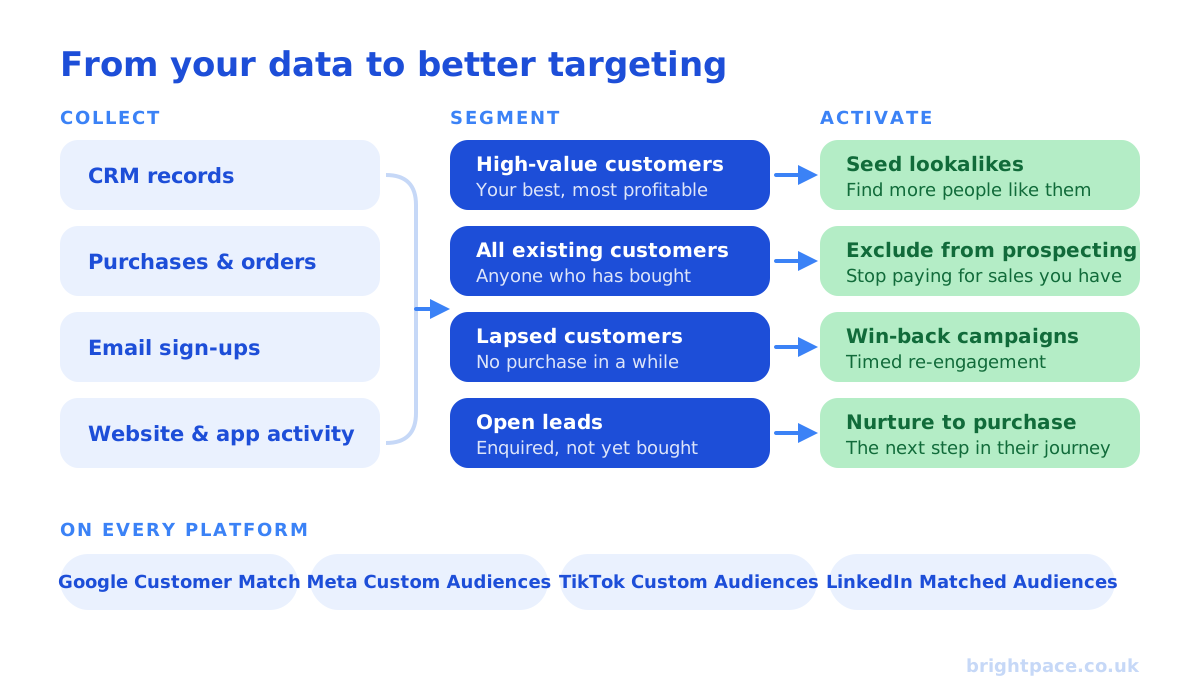
First-party data does four distinct jobs in targeting. Most brands only use the first.
1. Retarget people who already know you
Website visitors, basket abandoners, past enquirers and email subscribers are warm audiences. Retargeting them with relevant messages, the product they viewed, the next step in their journey, is the classic use. It works, but it’s the smallest opportunity, because these people have already found you.
2. Find more people like your best customers
Upload a list of your highest-value customers and the platforms can look for people who resemble them. Lookalike audiences on Meta and TikTok are built from a seed list, and first-party lists can be used as audience signals that guide AI campaigns such as Performance Max. The quality of the seed decides the quality of the result: a list of your most profitable repeat customers is a far better starting point than everyone who has ever bought once.
3. Stop paying to reach existing customers
Acquisition campaigns often spend heavily on people who would have bought anyway. Uploading customer lists lets you:
- Exclude existing customers from prospecting campaigns entirely
- Bid or value new customers differently: Google Ads’ new customer acquisition goal, for example, uses your customer lists to tell new buyers from existing ones
- Report honestly on how much spend really goes to new customers
This single step often has the biggest effect on efficiency, and it makes platform-reported results far more honest.
4. Re-engage customers at the right moment
Your data knows who bought a product that runs out, whose subscription is up for renewal and who hasn’t purchased in a year. Timed campaigns to those segments, replenishment, renewal, win-back, reach people when they’re most likely to act.
How to use first-party data on each platform
Each platform has its own name for uploading and using your data:
- Google Ads: Customer Match. Upload hashed customer lists to target, exclude or bid differently across Search, Shopping, YouTube, Gmail and Demand Gen, and use them as audience signals in Performance Max. See our Performance Max best practices. Website behaviour from GA4 can be shared too: see how to sync GA4 audiences to Google Ads.
- Meta: Custom Audiences. Build audiences from customer lists, website and app activity, and engagement, then use them for retargeting, exclusions and as the seed for Lookalike Audiences. With Advantage+ audience, custom audiences act as suggestions the system can expand beyond.
- TikTok: Custom Audiences. Customer file, website and engagement audiences for retargeting and exclusion, plus lookalikes. See TikTok Smart+ best practices.
- LinkedIn, Matched Audiences. Upload contact or company lists for account-based marketing, so B2B campaigns reach the buying groups you actually want, central to how we run LinkedIn ads and our B2B approach.
- Microsoft Advertising: Customer Match. Similar list-based targeting for Bing and the Microsoft network.
Customer information is hashed (converted to an irreversible code) before matching, and each platform sets its own eligibility rules, list sizes and policies: check them before you rely on a list.
First-party data also powers measurement
Targeting and measurement use the same data. Passing conversion data from your own systems back to the platforms, through the Meta Conversions API, Google’s enhanced conversions and offline conversion imports, does two things:
- It recovers conversions browser tracking misses, so the platforms learn from a fuller picture
- It lets you optimise toward real outcomes, qualified leads, profitable orders, high-value customers, instead of form-fills and clicks
Better conversion data makes every audience you build work harder, because the algorithm knows what a good result looks like. It’s the foundation of structuring campaigns so automation works for you.
How to build a first-party data strategy
- Audit what you already hold. CRM, ecommerce platform, email tool, booking system, analytics. Most businesses have more usable data than they realise, spread across tools that don’t talk to each other.
- Make sure you can use it. Check your consent wording and privacy policy cover advertising use, and that your consent banner controls both browser and server-side tags.
- Create a clear value exchange. People share data when they get something back: an account with order tracking, a loyalty scheme, useful content, a quiz, early access or a genuinely useful newsletter.
- Clean and connect it. Deduplicate records, standardise email and phone formats, and connect your CRM to the ad platforms, directly, through a connector or with tools such as Google Ads Data Manager, so lists stay fresh automatically. Tag every campaign link consistently too: our UTM builder keeps naming clean.
- Segment by value, not just by status. Separate high-value, repeat, recent, lapsed and one-off customers, and leads by stage. The segments you create decide the targeting options you have.
- Activate on every platform. Seed lookalikes with your best customers, exclude existing customers from acquisition, and build win-back and nurture campaigns.
- Refresh and measure. Stale lists lose value quickly. Update them regularly, and compare results for new versus existing customers so you can see the difference first-party data makes.
Privacy and consent
First-party data is only an asset if it’s collected and used lawfully. In the UK, using personal data for advertising needs a lawful basis under UK GDPR, and cookies and similar tracking need consent under PECR. In practice:
- Tell people clearly how their data will be used, including for advertising
- Respect opt-outs and consent choices: in the browser and on the server
- Only upload what you need, and let platforms hash customer information as required
- Keep lists up to date so people who’ve unsubscribed or asked to be forgotten are removed
Handled properly, privacy isn’t a limitation on first-party data: it’s what makes it durable.
Common mistakes
- Using first-party data only for retargeting, and ignoring exclusions and lookalikes
- Seeding lookalikes with every customer rather than the most valuable ones
- Letting acquisition campaigns spend on existing customers
- Uploading a list once and never refreshing it
- Collecting data without clear consent for advertising use
- Keeping CRM outcomes out of the ad platforms, so they optimise to leads that never buy
FAQs
What’s the difference between first-party and zero-party data?
Zero-party data is information customers deliberately tell you, such as preferences, quiz answers or what they’re shopping for. First-party data also includes what you observe, such as purchases and site behaviour. Both are yours, and both are valuable for targeting and personalisation.
How big does a customer list need to be?
Each platform sets its own minimum number of matched people before a list can be used, and match rates are rarely 100%. Bigger, cleaner lists, with emails and phone numbers in the right format, match better.
How often should I refresh customer lists?
At least monthly, and ideally automatically through a CRM or ecommerce integration. Stale lists miss new customers and can keep showing ads to people who’ve opted out.
Do I need consent to upload customer lists to ad platforms?
You need a lawful basis under UK GDPR and clear privacy information that explains advertising use, and you must respect opt-outs. Check your privacy policy and consent wording before uploading any list.
In short
First-party data is now the foundation of ad targeting. Use it to retarget warm audiences, find more people like your best customers, stop paying to reach existing ones and re-engage people at the right moment: on every platform you run. Build it through a genuine value exchange, keep it clean and connected, respect consent, and feed your conversion data back too, so the algorithms know exactly who you want more of.
Sources
The platform documentation and coverage this guide is checked against. Last checked October 2026.
- About Customer Match, Google Ads Help
- About customer list Custom Audiences, Meta Business Help Centre
- About enhanced conversions, Google Ads Help
- Conversions API, Meta for Developers
- Cookies and similar technologies (guide to PECR), ICO
Want to put your first-party data to work? It’s built into how we run paid search and paid social. Let’s chat, or have us review your setup with a paid audit.
Want a senior eye on your paid media strategy?
Work directly with the founder: no juniors, no hand-offs, 30-day rolling contracts.