Meta now lets you choose an attribution model for each ad set. Standard attribution, by default 7-day click or 1-day view, optimises toward people likely to convert within those windows and credits any conversion that happens inside them. Incremental attribution optimises toward conversions Meta predicts your ads actually caused, and reports only those. The difference sounds technical, but it changes who your ads are shown to, what your dashboard reports and how you should judge success.
What does 7-day click, 1-day view mean? It’s Meta’s default attribution setting. A sale or lead is credited to your ad if it happens within 7 days of someone clicking the ad, or within 1 day of them seeing it without clicking. It counts conversions that happened after the ad, not only those the ad caused.
Here’s what each one does, when to use which, and how to test the switch without fooling yourself.
At a glance
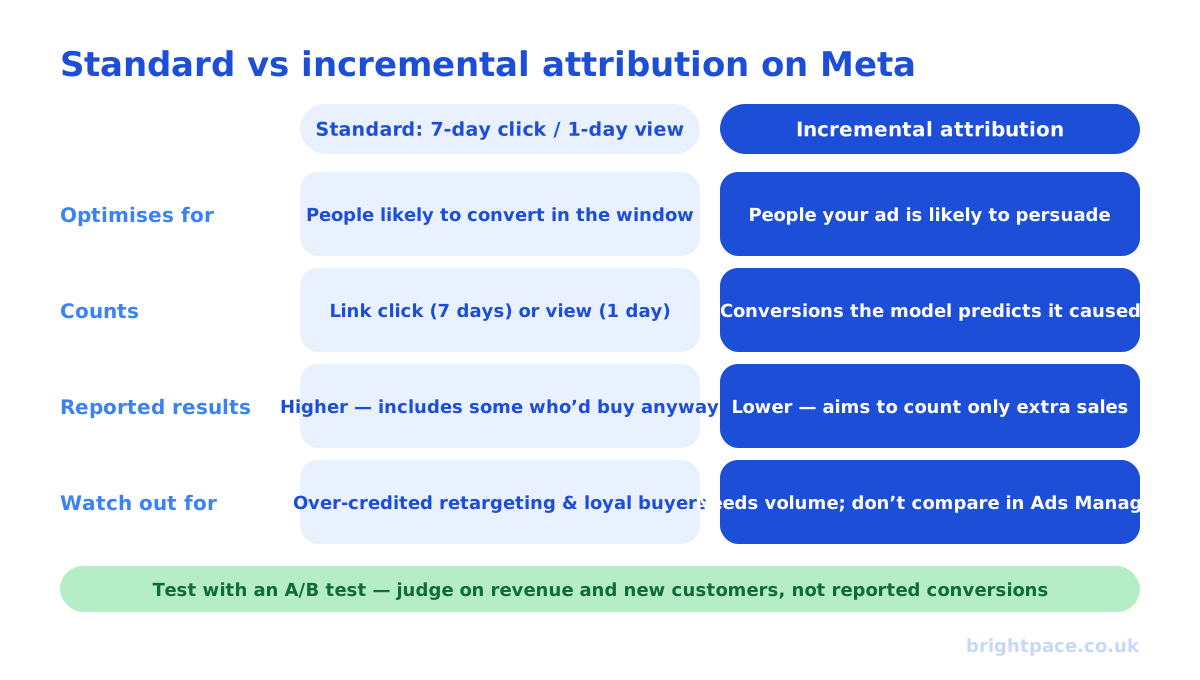
| Standard: 7-day click or 1-day view | Incremental attribution | |
|---|---|---|
| Optimises for | People likely to convert within the attribution window | People whose conversion your ad is likely to cause |
| Counts | Conversions after a link click (7 days) or an ad view (1 day) | Conversions Meta’s models predict were caused by the ad |
| Reported numbers | Higher, includes some people who’d have bought anyway | Lower, aims to count only the extra sales |
| Main risk | Over-crediting retargeting and loyal customers | Fewer reported results, which can look like a drop |
| Best for | Established reporting, low-volume accounts, simple comparisons | Accounts that care about true growth and new customers |
What 7-day click, 1-day view actually counts
Standard attribution gives your ads credit for a conversion that happens within a set window after someone interacts with them. With the default setting, that means:
- 7-day click: a conversion within seven days of someone clicking a link in your ad. Since Meta’s 2026 update, click-through counts link clicks only.
- 1-day view: a conversion within one day of someone seeing your ad, even without clicking.
Meta has also introduced engage-through attribution: a conversion within one day of a non-link interaction, such as a like, save or share, or a video watched for at least five seconds. It’s rolling out gradually, so some accounts still use the previous definitions.
The key point is that standard attribution measures timing, not cause. If someone was already going to buy, a loyal customer, or someone who’d already searched for your brand, and they happened to see your ad the day before, that sale is credited to the ad.
Why standard attribution can over-credit
That’s not a flaw so much as a limit of what time windows can tell you. But it has real consequences:
- Retargeting looks brilliant. People who’ve just visited your site were likely to buy anyway, and they’re the easiest to credit inside a window.
- Existing customers inflate results. Repeat buyers convert often, whether or not they see an ad.
- The algorithm learns the easy path. Because delivery optimises toward people likely to convert in the window, it can drift toward people who’d convert regardless: the opposite of growth.
You end up with a flattering ROAS in Ads Manager while the business grows more slowly than the dashboard suggests: the gap we explain in commercial alignment over channel metrics.
What incremental attribution does differently
Incremental attribution drops the time windows. Instead, Meta uses machine-learning models to predict whether each conversion was caused by your ad: whether it would have happened without it. That changes two things:
- Delivery. The ad set optimises toward people whose purchase your ad is likely to make happen, rather than people likely to buy anyway.
- Reporting. Results show incremental conversions, the ones the model attributes to the ad’s influence, rather than every conversion inside a window.
Because it counts only the extra sales, incremental attribution usually reports fewer conversions and a higher cost per result than 7-day click, 1-day view. That doesn’t mean performance got worse. It means the number is trying to answer a harder, more useful question.
Which should you use?
Incremental attribution tends to suit you when:
- Growth and new customers matter more than a tidy platform ROAS
- A large share of your results come from retargeting or existing customers
- You have enough conversion volume for the models to learn
- You’re comfortable judging Meta on business results rather than Ads Manager alone
Standard attribution tends to suit you when:
- Conversion volume is low and you need every signal to exit the learning phase
- You need consistent reporting against previous periods
- Your sales cycle is short and most conversions are clearly driven by clicks
- You’re not yet able to measure results outside the platform
Many advertisers run both: standard attribution where volume is thin, and incremental attribution on larger prospecting ad sets where it can learn properly.
How to test incremental attribution properly
The biggest mistake is comparing the two in the Ads Manager overview. Meta itself warns that results can’t be compared across ad sets using different attribution models, because each counts conversions differently. Test it like this instead:
- Use a controlled test. Run Meta’s A/B testing tool with two identical campaigns or ad sets, same audience, creative and budget, where only the attribution model differs.
- Choose a business metric first. Decide up front what you’ll judge on: blended revenue, new customers, orders in your own system or cost per new customer, not the conversions each ad set reports.
- Give it time. Changing the attribution model starts a new learning period. Run the test for several weeks and through a full sales cycle.
- Check your signal quality. Accurate events and values matter even more when the model is predicting causation. Make sure the Meta Conversions API is set up and deduplicated.
- Read the result in your own data. If the incremental ad set drives the same or more real revenue and new customers, even while reporting fewer conversions, it’s doing its job.
For the strongest answer, pair it with a conversion lift study or a geo holdout test, which measure incrementality directly rather than through a model. Our free incrementality calculator turns test and control results into lift, extra conversions and incremental ROAS, and our guide to lift tests shows how to set one up on each platform.
How to switch it on
At the ad set level, in the conversion section, open Show more options and choose the attribution model. Incremental attribution isn’t available for every campaign type and objective, so if you don’t see it, it may not be supported for that setup yet. Treat the change as a new starting point: expect a learning period, and don’t compare the new numbers directly with the old ones.
Common mistakes
- Comparing incremental and standard ad sets side by side in Ads Manager
- Judging the switch on reported conversions, which will almost always fall
- Switching low-volume ad sets that then struggle to learn
- Changing the attribution model alongside creative, budget and audience at the same time
- Assuming incremental attribution replaces proper lift or holdout tests
- Ignoring signal quality: weak tracking undermines any model
Key FAQs
Is incremental attribution better than 7-day click, 1-day view?
It answers a better question, did the ad cause the sale?, but whether it improves results for your business depends on your mix of prospecting and retargeting, your conversion volume and how you measure success. Test it rather than assume.
Why did my reported conversions drop after switching?
Because incremental attribution only counts conversions Meta predicts the ad caused. Sales from people who would have bought anyway are no longer credited. Check your own revenue and new-customer numbers before deciding it’s worse.
Can I compare ad sets that use different attribution models?
Not directly in the campaign overview: Meta warns that the counting methods differ. Use a controlled A/B test and judge both on the same external business metric.
Does incremental attribution replace lift studies?
No. It’s a model making predictions at scale. Conversion lift studies and geo holdout tests measure incrementality directly, and are the best way to check the model’s view against reality.
Do I need the Conversions API?
It isn’t required, but better data helps any model. Accurate, deduplicated events and values give incremental attribution, and standard attribution, more to learn from.
In short
Standard 7-day click, 1-day view credits conversions by timing, which makes it easy to read but prone to over-crediting people who would have bought anyway. Incremental attribution optimises for, and reports, the conversions your ads actually cause: fewer on paper, but closer to real growth. Test it on well-funded ad sets with a controlled A/B test, judge it on your own revenue and new-customer data, and keep lift tests as the final word. For more on how Meta decides who sees your ads, read Meta Andromeda: creative is the new targeting.
Sources
The platform documentation and coverage this guide is checked against. Last checked October 2026.
- About incremental attribution, Meta Business Help Centre
- About attribution settings, Meta Business Help Centre
- Meta shares more info on incremental attribution tracking, Social Media Today
- About A/B testing, Meta Business Help Centre
Want to know what Meta is really adding to your business? Our incrementality testing service designs and reads out lift tests, and it’s how we run Meta ads and paid social, measured on incremental revenue, not platform credit. Let’s chat, or have us review your setup with a paid audit.
Want a senior eye on your paid social?
Work directly with the founder: no juniors, no hand-offs, 30-day rolling contracts.