Generative Engine Optimisation (GEO) is the practice of making your brand more likely to be surfaced, cited and recommended inside AI-generated answers: the responses people now get from ChatGPT, Google’s AI Overviews, Perplexity and Copilot instead of a page of blue links. Where classic SEO fights for a ranking position, GEO fights to be the answer, or part of it.
For a growing share of buyers, the journey no longer starts with a search box and ten results. It starts with a question and a single, synthesised reply. If your brand isn’t in that reply, you’re not on page two: you’re invisible. Here’s how GEO works, how it differs from SEO, and where the emerging world of ChatGPT ads fits alongside it.
What is Generative Engine Optimisation (GEO)?
GEO is optimising your content, data and reputation so that large language models (LLMs) reference your brand when they answer a relevant question. Instead of targeting a keyword and a ranking slot, you’re targeting a citation: being named, quoted or linked in the model’s response.
In practice, an AI answer is assembled from two things: what the model already “knows” from training, and what it retrieves live from the web at answer time. GEO works on both: making your brand part of the broader consensus the model has absorbed, and making your pages the clean, quotable source it pulls when it retrieves.
Why GEO matters now
Three shifts make this urgent rather than theoretical:
- The answer is replacing the list. AI Overviews and assistants increasingly resolve a query in one response, compressing ten results into one. Fewer clicks reach the open web, so being in the answer matters more than ranking below it.
- Intent is higher, not lower. People ask assistants detailed, commercial questions: “best CRM for a 20-person B2B team”, “is X worth it versus Y”. That’s bottom-of-funnel demand, decided inside the conversation.
- Advertising has arrived in the answer. ChatGPT ads are now live in the UK, so the answer is a paid channel too. OpenAI says ads don’t influence the answers themselves, which is exactly why the organic groundwork of GEO still matters alongside paid.
GEO vs SEO: what’s actually different
GEO doesn’t replace SEO: it extends it. Much of the foundation is shared (fast, crawlable, trustworthy pages), but the target changes:
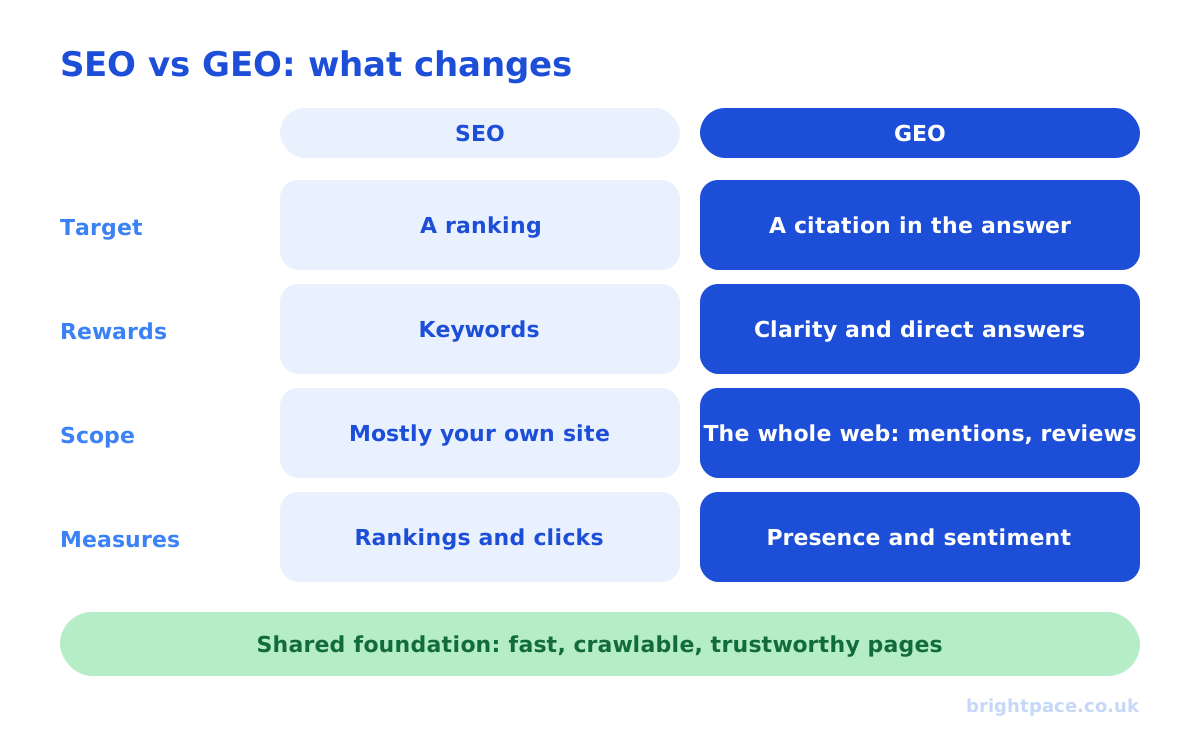
- SEO targets a ranking; GEO targets a citation. You want to be quoted, not just listed.
- SEO rewards keywords; GEO rewards clarity. Models extract clean, self-contained statements. A crisp definition or a direct answer to a question is far more “liftable” than keyword-stuffed prose.
- SEO is mostly your site; GEO is the whole web. Models synthesise consensus across sources, so third-party mentions, reviews and comparisons shape what they say about you as much as your own pages do.
- SEO measures rankings and clicks; GEO measures presence and sentiment: whether you’re mentioned, how you’re described, and whether you’re recommended.
How to get your brand cited in ChatGPT and AI answers
GEO is earned, not bought: here’s a practical checklist:
- Answer real questions, plainly. Structure content around the exact questions buyers ask, and answer each in the first line or two: before the context. Models lift self-contained answers; a clear FAQ or a definition up top does a lot of the work.
- Make claims quotable and specific. “We cut cost per lead by 45% in 90 days” is liftable; “we drive great results” is not. Concrete, attributable statements get cited.
- Earn third-party mentions. Reviews, roundups, comparisons, PR and directory listings feed the consensus the model learns. Being named as a “best X for Y” across independent sources is GEO gold.
- Keep your structured data clean. Schema (Organization, Service, FAQ, Product) helps machines understand who you are, what you do and where: the same technical SEO that helps Google also helps LLMs.
- Be consistent everywhere. Same name, positioning and facts across your site, profiles and listings, so the model forms one coherent picture rather than a fuzzy one.
- Stay fresh and factual. Up-to-date, accurate pages are more likely to be retrieved and trusted, and less likely to be contradicted by a newer source.
Notice how much of this overlaps with simply being a clear, credible, well-run brand. GEO rewards substance; there’s no keyword trick to shortcut it.
Where ChatGPT ads fit
GEO is the organic side. The paid side is now here: ChatGPT ads are live in the UK, shown alongside answers when they’re relevant to the conversation and clearly labelled as sponsored. It’s a genuinely new, high-intent channel, and because it’s new, the smart play is to test early with a clear budget and measure properly, rather than wait or scale blindly.
The two work best together. GEO builds the presence that makes you a credible answer; paid placements buy visibility at the decisive moment in the conversation. We cover the paid side in depth on our ChatGPT ads page (and how AI assistants can now work inside your ad accounts in our guide to ad platform MCPs), and it slots into the same unified media plan as your PPC and paid search: one commercial strategy, not a bolted-on experiment.
How to measure GEO and AI advertising
A new channel demands honest measurement, not vanity metrics:
- Track your presence. Regularly ask the assistants the questions your buyers ask, and log whether you appear, how you’re described, and who’s recommended instead. That’s your GEO baseline.
- Watch for AI referral traffic. Referrals from ChatGPT, Perplexity and AI Overviews are showing up in analytics: small today, growing fast. Segment and trend them.
- Measure incrementality on paid. For ChatGPT ads, insist on server-side tracking, first-party data and proper incrementality thinking: the same discipline we apply to profit-based ROAS targets, so you scale on evidence, not novelty.
FAQs
Can you pay to appear in ChatGPT’s answers?
No. ChatGPT ads appear alongside answers and are labelled as sponsored, and OpenAI says ads don’t influence what ChatGPT says. Being named in the answer itself has to be earned: that’s GEO.
How long does GEO take to work?
It depends on where the answer comes from. Assistants that search the web live can pick up new or improved pages within weeks; what a model learned in training changes much more slowly. Treat GEO as a steady, ongoing effort rather than a quick fix.
Does llms.txt help with GEO?
It’s a proposed standard: a plain-text file that summarises your site for AI tools. It’s quick to add, but it isn’t confirmed to be used by the major assistants, so treat it as a nice extra, not a priority over clear pages and third-party mentions.
Is GEO a replacement for SEO?
No. GEO builds on SEO: fast, crawlable, trustworthy pages still matter. GEO adds a focus on clear, quotable answers and on what other sites say about you.
In short
GEO is SEO’s next chapter: earning your place inside the answer, not just below it. Answer real questions plainly, make your claims specific and quotable, earn third-party mentions, and keep your data clean and consistent. Do that, and you build the credibility that makes ChatGPT and other assistants recommend you, and the foundation that makes the emerging world of ChatGPT ads pay.
Sources
The platform documentation and coverage this guide is checked against. Last checked October 2026.
- GEO: Generative Engine Optimization (Aggarwal et al.), arXiv
- About ads and AI Overviews, Google Ads Help
- ChatGPT ads go live in the UK as OpenAI expands pilot beyond US, PPC Land
Want to get ahead on AI search while it’s still early? Explore our ChatGPT ads and media management, or let’s chat about where AI answers are already shaping your demand.
Want a senior eye on your AI search and ChatGPT ads?
Work directly with the founder: no juniors, no hand-offs, 30-day rolling contracts.