The real cost of in-housing paid media isn’t the salary: it’s salary plus on-costs, tools, training, management time, and the performance risk during the ramp-up. Compared like-for-like, both an in-house team and an agency often cost more than they first appear, and the right answer depends less on price than on your volume, complexity and growth stage.
Here’s how to compare them honestly, with a cost model you can fill in with your own numbers.
Count the full cost of in-house, not just the salary
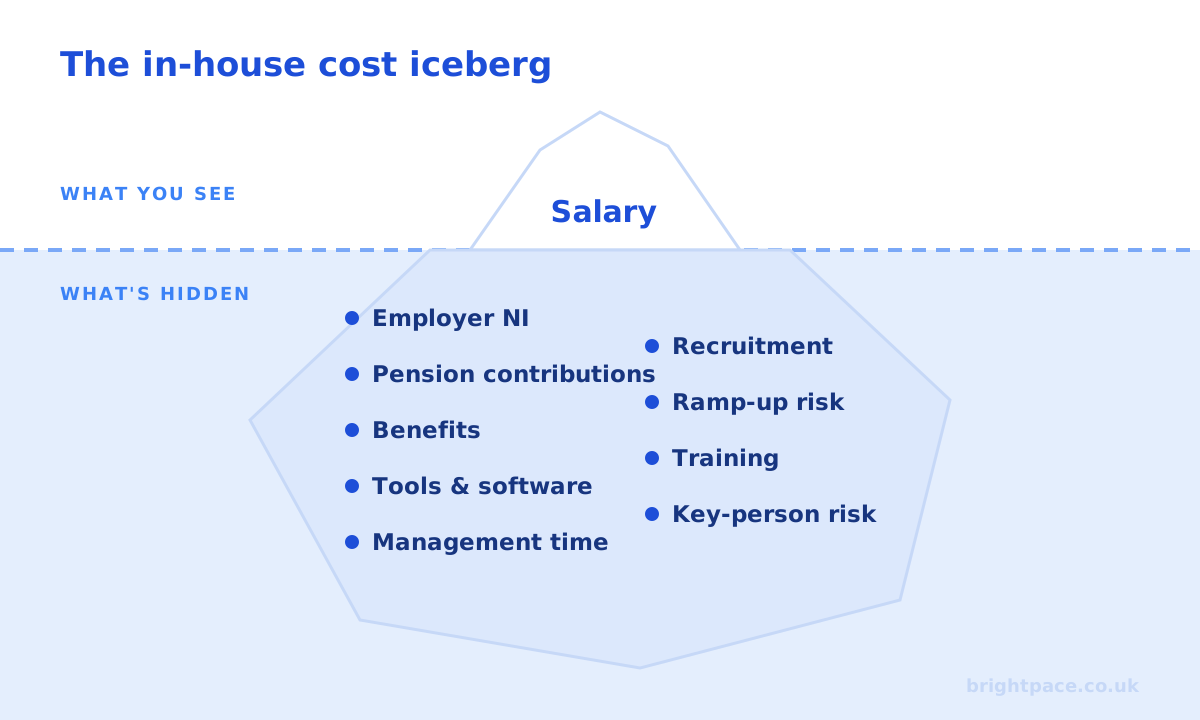
A single mid-level paid media manager looks cheaper than an agency retainer: until you add everything around them:
- Salary plus on-costs. In the UK, employer National Insurance is 15% on earnings above the secondary threshold, and auto-enrolment requires an employer pension contribution of at least 3% of qualifying earnings. Add benefits and on-costs are commonly 20–30% on top of base salary.
- Tools. Reporting and dashboards, bid management, keyword and competitor research, creative tools and feed management.
- Management overhead. Someone senior has to direct, review and challenge the work: that time has a cost too.
- Recruitment and ramp-up. Hiring takes months, and it takes longer still for a new hire to learn your account, your customers and your data.
- Training. Platforms change constantly; staying current takes time and budget.
- Key-person risk. When someone leaves, much of the knowledge leaves with them, and the recruitment cycle starts again.
One person also can’t be equally strong across paid search, paid social and programmatic. You’re usually buying one specialism and hoping it stretches.
Count the full value of an agency, not just the fee
An agency fee buys more than hours:
- Specialist depth across channels, not a single generalist
- Cross-account pattern recognition: they’ve often seen your problem before
- No ramp-up risk and no gap when someone’s on holiday or leaves
- Flexibility: scale up or down without a recruitment or redundancy process
- Tools included: agencies usually already pay for the software stack
The trade-offs: a traditional agency can feel distant, you may get junior people on your account after a senior pitch, long contracts can lock you in, and you don’t own the capability long-term.
A simple cost model you can fill in
Put both options side by side over the same period, a year works well, using your own figures:
| Cost line | In-house | Agency |
|---|---|---|
| People | Salaries × (1 + on-cost %) | Monthly fee × 12 |
| Tools and software | Annual licences | Usually included: check |
| Management time | Senior hours × internal day rate | Lower, but not zero |
| Recruitment | Fees or internal time, per hire | None |
| Training | Courses, conferences, time | Included |
| Ramp-up risk | Estimated performance dip while learning | Onboarding period |
| Cover and continuity | Holiday, sickness, leavers | Covered by the agency |
| Exit costs | Notice periods, rehiring | Contract notice period |
Then set the total against what each option is likely to deliver. A cheaper option that runs your media less effectively can easily cost more in wasted spend than it saves in fees, especially at higher budgets. Use our ROAS and CPA calculators to see what a small change in efficiency is worth at your level of spend.
The comparison most people miss: capability transfer
The either/or framing is usually wrong. The best outcome is often a partner who builds your team’s capability while running the work, so you get senior expertise now and an in-house function later, without the cliff-edge risk of switching cold.
That’s the model we favour: work as a senior extension of your team, then hand over the controls when your team is ready. Our consultancy service is built around exactly this: see our in-housing roadmap for how the handover works.
Hybrid models worth considering
- In-house execution, external strategy. Your team runs campaigns day to day; a senior consultant sets direction and reviews performance periodically.
- Split by channel. Keep your highest-volume channels in-house and use specialists for channels that need scarce skills, such as programmatic.
- Agency now, in-house later. An agency runs the work while training your team, with a planned handover date.
- In-house plus audits. Your team owns everything, with an independent paid audit once or twice a year as a quality check.
When each option tends to win
In-house tends to make sense when:
- Spend is large and steady enough to keep specialists fully productive
- Paid media is core to the business and needs daily, cross-team collaboration
- You can offer the career path and leadership that keep good people
- Speed and access to internal data matter more than outside perspective
An agency or partner tends to make sense when:
- Spend is moderate, seasonal or spread across several channels
- You need senior expertise quickly, without a long hiring process
- You want flexibility to scale up or down
- You don’t yet have someone senior to lead an in-house team
A simple way to decide
Ask three questions:
- Volume: is your spend big and consistent enough to keep a specialist fully productive? If not, a partner is usually more efficient.
- Complexity: one channel or several? Multi-channel needs multiple specialisms.
- Stage: scaling fast and need senior firepower now, or steady and building a long-term team?
There’s no universally right answer, but there is a right answer for your situation, and it’s rarely decided on headline price alone.
The risks of in-housing paid media
In-housing can work well, but the risks are easy to underestimate:
- A dip during the handover. Results often fall while a new team learns the account, especially if the change happens all at once or just before a peak like Black Friday.
- One person, one point of failure. With a single hire, holidays, sickness or a resignation leave nobody running your spend.
- Losing your benchmark. An in-house team only sees your account, so it’s harder to know whether a cost per sale is good or just normal for you.
- Skills going stale. Platforms change every few months. Without time and budget for training, a team drifts behind.
- Losing history and setup. If the agency owns your ad accounts, tracking or reports, you can lose data when you move. Check ownership before you give notice.
- Hiring the wrong person. A strong interview doesn’t guarantee strong results, and finding out takes months of spend.
Most of these can be managed with a phased handover, accounts in your own name and outside support for audits or specialist channels. Our in-housing roadmap shows how.
Questions to ask before you decide
- Who exactly will work on our account, and how senior are they?
- Do we own our ad accounts, pixels and data either way?
- What’s the notice period? (Ours are 30-day rolling.)
- If we hire in-house, who will lead and develop that person?
- What happens to performance during the transition, and how will we measure it?
FAQs
Is in-housing cheaper than an agency?
Not always. Once you add on-costs, tools, management time and ramp-up, one in-house hire often costs as much as an agency retainer, while covering fewer channels. In-housing tends to become cheaper at higher spend, when you need a team of several people working full-time on your accounts anyway.
What are the hidden costs of in-housing PPC?
Employer National Insurance and pension, benefits, software licences, recruitment fees, training, the senior time needed to manage the team, and the performance dip while new people learn the account. Cover for holidays and leavers is a hidden cost too.
What does it cost to run Meta ads in-house?
Salary plus 20–30% on-costs for whoever runs it, plus a steady supply of new creative, which on Meta is a real ongoing cost, plus any tools. For example, a £45,000 paid social manager costs roughly £54,000–£58,500 a year before creative and tools. See our guide to what Meta ads cost in the UK for ad spend and creative.
Is a freelancer cheaper than an agency?
Often per day: UK freelance PPC specialists commonly charge around £200–£650 a day depending on seniority. But capacity, holiday cover and breadth across channels can be limited. Our guide to what PPC management costs compares the options.
How long does it take to bring paid media in-house?
Usually several months: recruiting, onboarding and then a phased handover so performance doesn’t dip. Our in-housing roadmap sets out the steps.
What should we own if we use an agency?
Your ad accounts, pixels, tag manager, analytics and data should all be in your name, with the agency given access. That keeps your history and makes it easy to change agency or move in-house later.
Can we combine in-house and agency support?
Yes, and many brands do: for example, your team runs day-to-day activity while a specialist handles strategy, a hard-to-hire channel such as programmatic, or periodic independent audits.
In short
Compare total cost of ownership, not salary versus fee. Factor in on-costs, tools, management, risk and ramp-up, and weigh cost against the performance each option is likely to deliver. And remember the strongest option is often a partner who improves your team while delivering, not a binary choice between the two.
Sources
The official rates behind the employment cost figures. Salary and freelance day rates are typical market ranges, not official figures. Last checked October 2026.
- Rates and thresholds for employers 2026 to 2027, GOV.UK
- National Insurance rates and categories, GOV.UK
- Workplace pensions: what you, your employer and the government pay, GOV.UK
Weighing up in-housing? A Brightpace consultancy engagement can model the options for your specific setup and build a roadmap either way. Let’s chat, or read about how we work.
Want a senior eye on your in-housing plans?
Work directly with the founder: no juniors, no hand-offs, 30-day rolling contracts.