On this page
- First, decide why: and what, you’re in-housing
- Step 1: Secure ownership and access
- Step 2: Audit before you move
- Step 3: Build the right team
- Step 4: Transfer capability, not just access
- Step 5: Set up the foundations
- Step 6: Phase the handover, don’t flip a switch
- Step 7: Measure the transition
- Step 8: Keep a line to senior expertise
- Common in-housing mistakes
- FAQs
- In short
- Sources
In-housing paid media is the process of moving day-to-day ownership of your advertising from an agency to your own team: done well, it follows a structured roadmap that transfers capability without dropping performance. The risk isn’t the tools or the logins; it’s losing the judgement and momentum that made the account work. A clear roadmap protects both.
This guide covers deciding what to in-house, the team you’ll need, a phased handover plan, what to document, and how to measure whether the move is working.
First, decide why: and what, you’re in-housing
In-housing isn’t all-or-nothing. Be specific about the goal:
- Cost and control: you want ownership, transparency and faster iteration
- Capability: you want the knowledge to live in-house permanently
- Hybrid: run some channels in-house, keep specialist support for others
The true cost comparison matters here: factor in salaries and on-costs, tools, management time and ramp-up, not just salary versus agency fee.
A common and sensible hybrid is to in-house the channels closest to your core business, often paid search and Meta, while keeping specialist help for channels that need scarce skills or scale, such as programmatic.
Step 1: Secure ownership and access
Before anything else, make sure the business owns its own assets. It’s surprisingly common for accounts to sit under an agency’s credentials.
- Ad accounts: Google Ads, Microsoft Advertising, Meta, TikTok, LinkedIn, owned by your business, with the agency added as a partner or user, not the other way round
- Business Manager / manager accounts: admin access held by at least two people in your company
- Analytics and tag management: GA4 properties, Google Tag Manager containers and any server-side tagging set up under your ownership
- Pixels, conversion APIs and product feeds: documented, with credentials stored securely
- Billing: on your payment method, so nothing stops if a relationship ends
Step 2: Audit before you move
Never in-house a black box. Establish a clear baseline first: what’s running, why, how it’s structured and how well it performs. A proper account audit protects performance through the transition and tells you what “good” looks like before anyone touches it.
Capture the baseline numbers you’ll judge the transition against, spend, revenue or pipeline, cost per acquisition, ROAS and new-customer share, over a representative period, adjusted for seasonality.
Step 3: Build the right team
One person rarely covers everything well. Map the skills you need against the channels you run:
- Channel execution: building, optimising and troubleshooting campaigns day to day
- Measurement: conversion tracking, analytics and attribution
- Creative and copy: especially for paid social, where creative drives performance
- Commercial planning: setting targets from margins, forecasting and budget allocation
- Leadership: someone senior enough to make trade-offs and challenge the numbers
Smaller teams often start with one strong generalist plus external support for measurement or specialist channels, then grow from there.
Step 4: Transfer capability, not just access
Handing over logins is the easy part. The real work is transferring the judgement:
- Why decisions get made, not just what the settings are
- How to read the data and spot what matters
- What to prioritise when time is tight
- The account’s history: what’s been tried, what failed and why
Document this. A well-run handover leaves your team with a playbook, not just a password.
What the handover document should include
- Account structure and the logic behind it
- Conversion actions, values and how they’re tracked
- Targets and how they were set from your economics
- Audiences, exclusions and negative keyword lists
- Creative learnings: what has and hasn’t worked (see creative testing frameworks)
- The optimisation routine: daily, weekly and monthly checks
- Seasonality, key dates and past promotions
- Known issues, open tests and the next planned actions
Step 5: Set up the foundations
Make sure the in-house team inherits solid ground:
- Clean measurement and clear commercial targets, not vanity metrics
- The right tools and reporting they can actually run
- Automation structured to work in their favour, not against them (how to do that)
- Simple calculators and processes, from ROAS targets to budget pacing, so decisions stay consistent
Step 6: Phase the handover, don’t flip a switch
Move in stages to keep performance steady:
- Shadow: the team observes and learns while the current owner runs it
- Co-pilot: the team runs it with support and review
- Own: the team leads, with a lighter check-in
- Independent: with the option of periodic strategic reviews
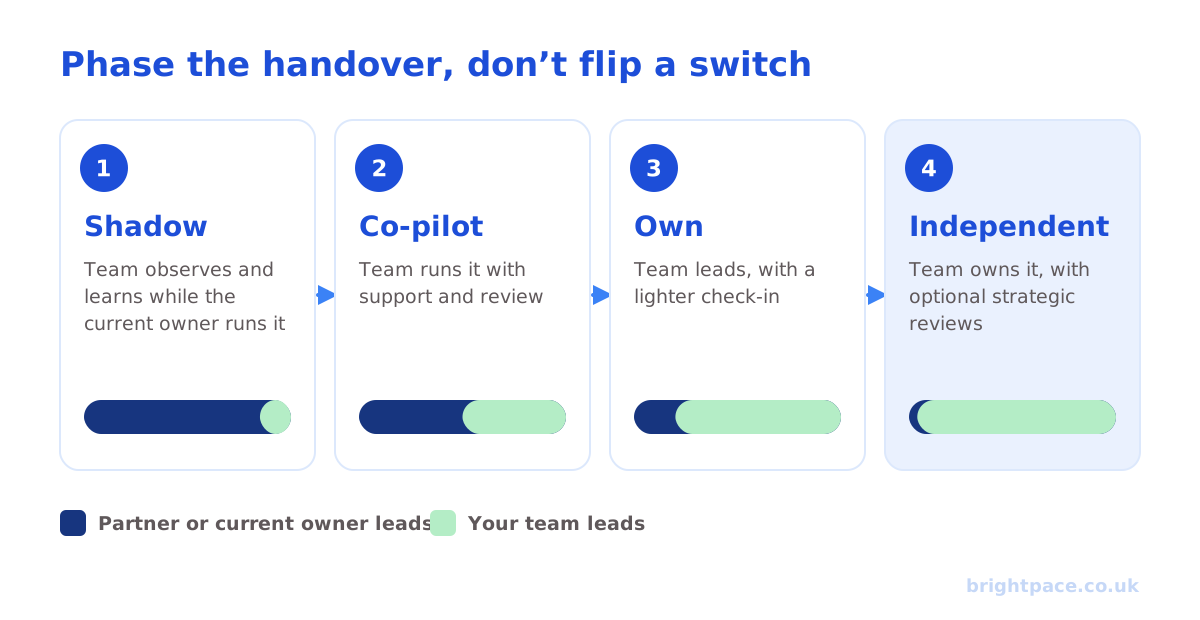
Each phase de-risks the next. A cold, overnight switch is where performance dips. Timelines vary with team experience and account complexity; a single-channel account can move faster than a multi-channel, multi-market one. Move to the next phase when the team is confident, not when a calendar says so.
Avoid scheduling the final handover just before a peak period such as Black Friday: give the team a quieter stretch to settle in.
Step 7: Measure the transition
Track whether in-housing is working with a short scorecard, reviewed monthly against your baseline:
- Performance: CPA, ROAS or pipeline versus the pre-transition baseline, seasonally adjusted
- Efficiency: blended acquisition cost across all channels
- Pace: how quickly the team can launch tests and act on results
- Capability: can the team explain why the account is set up the way it is?
Expect some wobble during the co-pilot phase. A sustained decline is a signal to slow down, not to push through.
Step 8: Keep a line to senior expertise
Even a capable in-house team benefits from an occasional senior pair of eyes: for a quarterly review, a new channel, a platform change or a tricky problem. In-housing the execution doesn’t mean losing access to the strategy.
Common in-housing mistakes
- Moving before securing ownership of accounts, pixels and analytics
- Hiring one person and expecting them to cover every channel expertly
- Handing over logins without the reasoning behind the setup
- Switching everything at once, just before a busy season
- Judging the team on week-one numbers instead of a seasonally adjusted baseline
FAQs
How long does it take to bring paid media in-house?
Usually a few months. A phased handover, channel by channel, with the agency or consultant overlapping for a period, is safer than switching everything on one date.
What should we do first when in-housing?
Make sure your business owns every ad account, pixel, analytics property and tag manager container, with admin access, before anything else changes.
Should we keep an agency after in-housing?
Many teams keep a light line to senior expertise, such as a monthly strategy session or audits, so the in-house team has a second opinion and stays current.
In short
Secure ownership, audit first, build the right team, transfer judgement not just access, lay clean foundations, phase the handover and measure it honestly, then keep a strategic line open. Done that way, in-housing builds lasting capability while the numbers keep moving in the right direction.
Sources
The platform documentation behind the ownership, access and measurement steps in this roadmap. Last checked October 2026.
- About Google Ads manager accounts, Google Ads Help
- Create a business portfolio in Meta Business Suite, Meta Business Help Centre
- Set up your web conversions, Google Ads Help
- About Conversions API, Meta Business Help Centre
- About Conversion Lift, Google Ads Help
Planning an in-housing move? Our consultancy is built around exactly this: audits, in-housing programmes and training. Let’s chat or read about how we work.
Want a senior eye on your in-housing plans?
Work directly with the founder: no juniors, no hand-offs, 30-day rolling contracts.