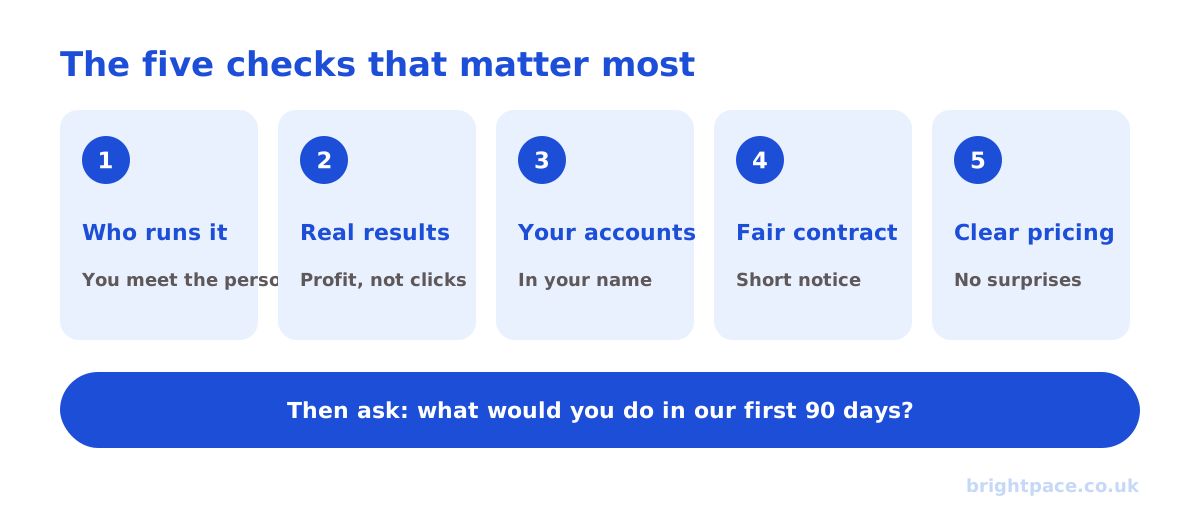
To choose a PPC agency, check five things before price: who will actually run your account, how they measure success (profit and real customers, not clicks), whether your accounts stay in your name, how long the contract ties you in, and how clearly they explain their pricing. Then ask them to walk you through how they’d approach your account in the first 90 days. A good agency will answer plainly; a weak one will talk about clicks, impressions and “proprietary technology”.
Below is a 12-point checklist you can use to compare agencies, the questions to ask on the first call, and the red flags that should make you walk away.
The 12-point checklist
Score each agency against these. You don’t need a perfect score, but the first five matter most.
- You know who runs your account. You should meet the person who will manage it day to day, not just the person selling it to you. Ask how many other accounts they look after.
- Success is measured on business results. Sales, leads that become customers, profit and new customers, not clicks, impressions or click-through rate. Ask what they’d report to you each week.
- Your accounts stay in your name. Google Ads, Microsoft Ads, Meta and analytics accounts should belong to you, with the agency given access. If they own the account, you can lose your history when you leave.
- The contract is fair. Six- to twelve-month minimum terms are common; a rolling monthly contract means the agency has to keep earning your business. Check the notice period.
- Pricing is clear and written down. You should know the fee, any minimum, any setup charge, and what’s not included. See our guide to what PPC management costs in the UK.
- Tracking comes first. A good agency checks your conversion tracking before spending more money. If they don’t ask how you track sales or leads, that’s a warning sign.
- Targets come from your numbers. They should ask about your margins, average order value or what a customer is worth, and set cost-per-sale or ROAS targets from them.
- They’ll tell you what’s genuinely working. Ask how they separate sales the ads caused from sales that would have happened anyway, such as brand searches and repeat customers. Look for words like incrementality, holdout tests and blended results.
- There’s a clear plan for the first 90 days. Audit, fixes, launch, testing, review: with priorities you can follow.
- Reporting is plain English and regular. You should get a regular report that explains what changed, why, and what’s next, not a 40-page export. Ask to see a sample: here’s ours, and see what a PPC report should include.
- They’re honest about fit. A good agency will say if your budget is too small, your tracking isn’t ready, or another channel would suit you better.
- Relevant experience, explained honestly. Ask what they’ve done in your sector or with similar budgets, and expect specifics, not vague claims or unverifiable stats.
Questions to ask on the first call
- Who will run our account day to day, and how many accounts do they manage?
- What would you look at first, and what do you expect to fix in the first month?
- How will you report results, and how often?
- How do you set targets, and what would you need from us to do that?
- How do you tell which sales your ads genuinely caused?
- Are our ad accounts and data in our name, and will they stay that way if we leave?
- What’s the total monthly cost, including any minimum fee or setup charge?
- What’s the minimum contract term and notice period?
- Is there a markup on ad spend, or are we billed by the platforms directly?
- What’s not included: creative, landing pages, tracking tools, call tracking?
Red flags
- Guaranteed results: no one can guarantee leads, sales or rankings from paid media.
- Talking mostly about clicks and impressions rather than sales, leads and profit.
- The agency owns your ad account or won’t give you full access.
- Long lock-in contracts with heavy exit terms.
- A “free audit” that’s really a sales pitch: a quick skim designed to find reasons to sell you a retainer.
- Vague pricing, hidden markups on ad spend, or fees that only appear after you sign.
- No questions about your margins, customers or tracking.
- A senior pitch, then a junior hand-off you never met.
Agency, freelancer or in-house?
An agency gives you a team or a dedicated specialist, usually on a percentage or retainer. A freelancer can be senior and cost-effective, but capacity and holiday cover can be limited. Bringing it in-house gives you the most control, but the real cost is much more than a salary: our in-house vs agency cost model shows how to compare. If you’re looking at London agencies specifically, our list of the best performance marketing agencies in London includes a short guide to choosing. For software companies, see the best B2B SaaS marketing agencies in the UK.
How to compare quotes fairly
Put every quote on the same basis:
- Total monthly cost: ad spend plus the management fee, including any minimum
- What’s included: how often the account is optimised, how results are reported, how often you speak
- Who does the work: and how senior they are
- Contract terms: minimum term and notice period
- Ownership: accounts and data in your name
The cheapest quote is rarely the cheapest outcome. A well-run account that cuts wasted spend can easily save more than the difference in fees.
Should you start with an audit?
If you already run ads, a paid, independent audit is a low-risk way to test an agency: you see how they think, what they’d fix and how they explain it, and you keep the action plan whatever you decide. Our Google Ads audit checklist lets you check the basics yourself first.
FAQs
How do I know if a PPC agency is any good?
Look at how they measure success, who runs the account and how clearly they explain their plan. A good agency talks about your margins, customers and tracking before clicks, and gives you plain-English reporting on results that matter to your business.
What should a PPC agency report on?
Sales or qualified leads, cost per customer, revenue and profit after ad spend, new versus returning customers, and what changed and why: with platform metrics like clicks as supporting detail.
How long should a PPC agency contract be?
Rolling monthly contracts are the most flexible. If an agency asks for a longer term, check the notice period and what happens to your accounts and data if you leave.
Should a PPC agency own my Google Ads account?
No. Your ad accounts should be in your name, with the agency given access. That way you keep your data and history whoever manages it.
How long does it take to see results from a new PPC agency?
Quick wins such as cutting wasted spend can show within weeks. Steady, efficient results usually take a couple of months of data and testing, which is why a clear 90-day plan matters.
In short
Choose a PPC agency on who runs your account, how they measure success, account ownership, contract terms and pricing clarity, then ask for their plan for your first 90 days. Avoid guarantees, lock-ins and anyone who talks more about clicks than customers. For a shortlist, see the 10 best PPC agencies in the UK, or the best paid social, eCommerce PPC, B2B PPC and LinkedIn Ads agencies.
Sources
The platform documentation behind the account ownership, access and tracking points in this checklist. Last checked October 2026.
- About Google Ads manager accounts, Google Ads Help
- Create a business portfolio in Meta Business Suite, Meta Business Help Centre
- Set up your web conversions, Google Ads Help
- About Conversions API, Meta Business Help Centre
Full disclosure: we’re a PPC agency, so we’d like to be on your shortlist. See how we work against this checklist, or let’s chat.
Want a senior eye on your paid search?
Work directly with the founder: no juniors, no hand-offs, 30-day rolling contracts.