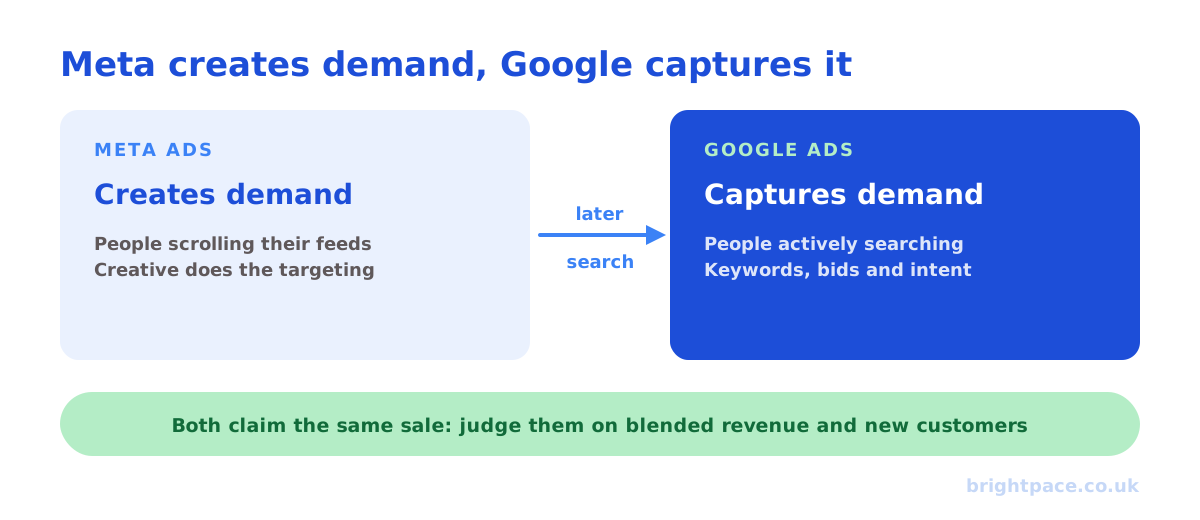
The main difference between Google Ads and Meta ads is intent. Google Ads shows your ads to people who are actively searching for what you sell, so it captures existing demand. Meta ads (Facebook and Instagram) show your ads to people scrolling their feeds who weren’t looking for you, so they create new demand. Most businesses should start where their customers already search, usually Google, and add Meta to reach people before they search. The right mix depends on what you sell, how people buy it, and how much creative you can produce.
This guide compares the two on the things that matter, then shows which to start with and how to run them together.
Google Ads vs Meta ads at a glance
| Google Ads | Meta ads | |
|---|---|---|
| How people find you | They search for it | You appear in their feed |
| Type of demand | Captures existing demand | Creates new demand |
| What drives results | Keywords, bids, landing page, conversion data | Creative, offer, conversion data |
| Targeting | Search terms, plus audiences and locations | Mostly automated: the creative does much of the targeting |
| Creative needs | Text ads, plus images and video for some campaign types | A steady flow of new images and video |
| Speed to results | Fast when demand exists | Fast to reach people; conversions can take more testing |
| Best for | Services people search for, high-intent products, local businesses | Visual products, impulse buys, new categories, broad audiences |
| Measurement risk | Brand searches and remarketing can look better than they are | View-through and retargeting can look better than they are |
How Google Ads works
When someone searches on Google, ads appear above and below the results for the searches you target. You pay when someone clicks. Because the person has just told Google what they want, the intent is high: someone searching “emergency plumber near me” or “running shoes for flat feet” is close to buying.
Google Ads also includes Shopping ads for retailers, Performance Max across all of Google’s channels, YouTube video, and Demand Gen for more visual, feed-style ads. But search is the core: it works best when people already know they need what you sell.
The limit is that Google can only capture demand that exists. If few people search for your product, there’s little to buy. See our PPC management service for how we run it.
How Meta ads work
Meta ads appear in Facebook and Instagram feeds, Stories and Reels. Nobody searched for you; the ad has to stop the scroll and make someone interested. Meta’s automation decides who sees each ad based largely on the creative itself, the message, format and angle, and on the conversion data you send back. We explain why in Meta Andromeda: creative is now your targeting.
That makes Meta powerful for reaching people who would never have searched: showing a product they didn’t know existed, or a solution to a problem they hadn’t put into words. It also means results depend heavily on a steady supply of fresh, genuinely different creative. See our Meta ads service.
Cost: which is cheaper?
There’s no simple answer, because you’re paying for different things. Google clicks often cost more, especially in competitive categories like legal, finance and insurance, but each click comes from someone actively looking. Meta’s cost to reach people is usually lower, but more of those people are at an earlier stage, so it can take more spend and more creative testing to turn them into customers.
For typical UK prices, see what Google Ads cost and what Meta ads cost. The fair comparison isn’t cost per click: it’s cost per customer and profit after ad spend. Work out what a customer is worth with our CPA calculator, then judge both platforms against it. Our guides to what PPC management costs and what Meta ads cost cover both platforms in more detail.
Which should you start with?
Start with Google Ads if:
- People already search for what you sell, or the problem it solves
- You’re a local or service business (trades, legal, dental, B2B services)
- You need enquiries quickly and can handle them
- You can’t yet produce new creative regularly
Start with Meta ads if:
- Your product is visual, new or bought on impulse
- Few people search for it, but many would want it once they saw it
- You can produce a steady flow of images and short video
- Your margins allow paying to find customers before they’re ready to search
Use both when you have the budget and tracking to measure them properly. They work best together: Meta creates interest, and Google captures it when those people later search for you.
Running Google and Meta together
The two platforms feed each other, which is also why they both over-claim. Someone sees your Instagram ad, searches your brand on Google a week later and buys. Meta counts it as a Meta sale; Google counts it as a Google sale. Add up what both report and you’ll often get more revenue than you actually made.
So when you run both:
- Judge them on blended results: total revenue against total ad spend (MER) and new customers, not each platform’s own report.
- Separate brand from non-brand search in Google, so you can see how much Meta is driving people to search for you.
- Test what each adds. Holdout and lift tests show which sales the ads genuinely cause: see our incrementality calculator and measurement service.
- Plan them as one budget, not two silos: the thinking behind one unified media plan.
Common mistakes
- Choosing on cost per click. The cheapest clicks are rarely the cheapest customers.
- Running Meta with one or two ads. Without new creative, results fade quickly.
- Running Google without tracking. If Google can’t see which clicks become customers, it can’t optimise: fix conversion tracking first.
- Adding up both platforms’ reported revenue. They count the same sales twice.
- Splitting a small budget too thinly. With limited spend, one well-run platform beats two underfunded ones.
FAQs
Is Google Ads or Facebook ads better for a small business?
For most small businesses selling services people search for, Google Ads is the better starting point because it reaches people who are already looking. Facebook and Instagram ads suit visual products and businesses that can produce new creative regularly.
Is Meta cheaper than Google Ads?
Meta often costs less to reach people, while Google clicks often cost more, but Google clicks come from people actively searching. Compare them on cost per customer and profit, not cost per click or impressions.
Can I run Google Ads and Meta ads at the same time?
Yes, and they often work best together. Just judge them on blended business results, because both platforms will claim credit for many of the same sales.
Which is better for B2B: Google or Meta?
For B2B, Google search usually captures buyers who are actively looking, and LinkedIn is better than Meta for targeting by job title. Meta can still work for reaching small-business owners at lower cost: see B2B performance marketing.
How much should I spend on each?
Work back from what a customer is worth and your target cost per customer. If you’re starting with one platform, put enough budget behind it to get regular conversions before adding the second. Our ad budget calculator helps.
In short
Google Ads captures demand from people already searching; Meta ads create demand by reaching people in their feeds. Start where your customers already search, add Meta when you can feed it creative and measure it properly, and judge both on blended profit and new customers rather than each platform’s own numbers.
Sources
The platform documentation this guide is checked against. Last checked October 2026.
- About Performance Max campaigns, Google Ads Help
- About ad auctions, Meta Business Help Centre
- About attribution models and attribution settings, Meta Business Help Centre
- About data-driven attribution, Google Ads Help
Not sure which platform fits your business? We run paid search and paid social as one plan, or start with a paid audit. Let’s chat.
Want a senior eye on your paid media strategy?
Work directly with the founder: no juniors, no hand-offs, 30-day rolling contracts.