Google Ads has no minimum spend: you set a daily budget and pay each time someone clicks your ad. Published 2026 UK benchmarks put the average Search cost per click at roughly £1.50–£2.50 for most businesses, from under £1 for many retail searches to £4–£15 or more in legal, finance and insurance. What you should spend depends less on the average click and more on how many clicks you need to win a customer, which you can work out from your conversion rate and what a customer is worth.
This guide covers what clicks cost by sector, how Google bills you, how to set a budget that can actually work, and the costs that sit on top of your ad spend.
The three costs of Google Ads
- Ad spend: what you pay Google for clicks. You set a daily budget for each campaign, and Google charges your card or invoices you as clicks come in.
- Management: the time to research keywords, build campaigns, write ads, manage bids and negative keywords and report on results, whether that’s you, an employee or an agency.
- Extras: landing pages that convert, call tracking, tools, and tax and fees on Google’s invoices.
The first is the one everyone asks about. The second and third are what decide whether that ad spend turns into customers.
What a click costs: UK benchmarks for 2026
Google doesn’t publish official averages, so UK benchmarks come from agencies’ own account data, and they vary. The two 2026 datasets we checked put the all-industry Search average at about £1.95 (Ridley Digital) and the typical small-business range at £1.50–£2.50 (Whito). Treat these as rough guides, because your own costs depend on your keywords, location and competition:
| Sector | Typical UK cost per click | Why |
|---|---|---|
| Local trades and home services | Often £1.50–£5 | Local searches, but urgent jobs attract plenty of bidders |
| eCommerce and retail | Often £0.40–£2 | Lower-value products, lots of searches |
| Travel and hospitality | Often £0.50–£2 | Many searches, with online travel agents bidding too |
| Dental and private healthcare | Often £1.50–£5, more for implants | High-value treatments in local markets |
| B2B and SaaS | Often £2–£6 | Valuable customers, narrower demand |
| Legal services | Often £4.50–£15, with some terms far higher | Very high-value cases and heavy competition |
| Finance and insurance | Often £3–£10 or more | Among the most competitive auctions |
Searches in London often cost more than the rest of the UK because more businesses compete for the same customers. To see estimates for your own keywords, use Google’s Keyword Planner inside Google Ads, and treat its figures as a starting point, not a quote.
For sector detail, see our guides to Google Ads costs for dentists, Google Ads for solicitors and Local Services Ads for trades.
How Google Ads billing works
- You pay per click on Search, Shopping and most Performance Max ads, not when your ad is shown.
- You don’t pay your maximum bid. In the auction, the price is set by the advertiser below you and your Ad Rank, so you usually pay less than the most you’d be willing to.
- Quality lowers your costs. Relevant ads and landing pages earn a higher Quality Score, which means a better position for the same price or the same position for less.
- Daily budgets are averages. Google can spend up to twice your daily budget on a busy day, but over a month it won’t charge more than your average daily budget × 30.4.
That last point catches people out: if your budget is £30 a day, some days you’ll see £50 or £60 spent, but your monthly bill won’t go over about £912.
How much budget do you need?
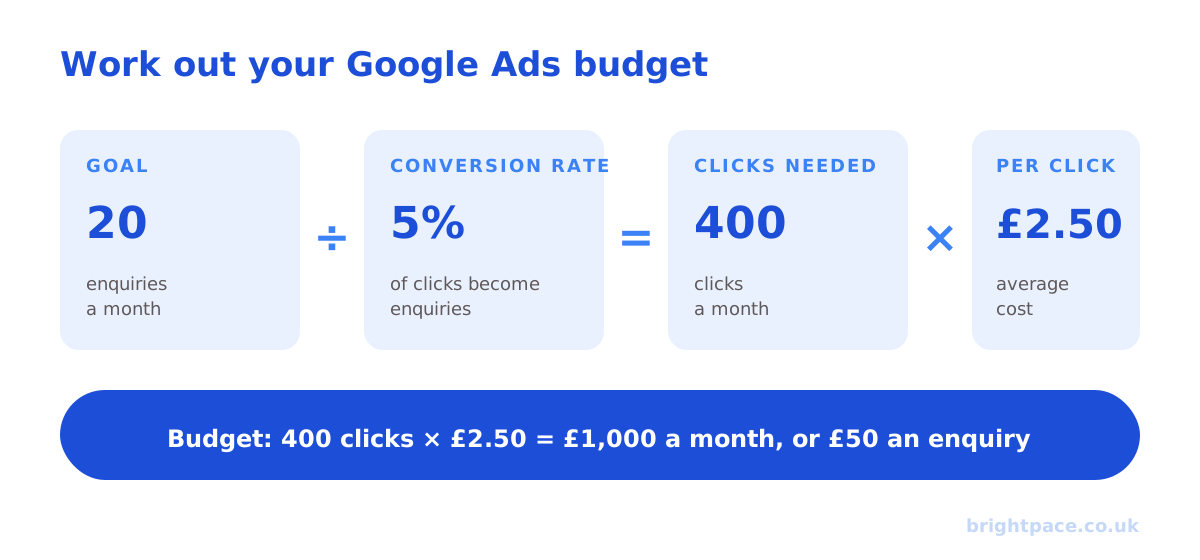
Start from the results you want, not from a round number:
- How many enquiries or sales do you want a month? Say 20.
- What share of clicks become enquiries? For a well-matched search and a good landing page, 3–10% is common. Say 5%, so you need 20 ÷ 5% = 400 clicks.
- What does a click cost? Say £2.50, so 400 × £2.50 = £1,000 a month.
Then check it’s worth it: £1,000 for 20 enquiries is £50 an enquiry. If one in four becomes a customer worth £600 to you, that’s £200 to win £600: profitable. Our CPA calculator and ad budget calculator do the maths for your own numbers.
Two more checks:
- Is there enough to learn from? Automated bidding such as Target CPA works best with a steady flow of conversions: Google’s guidance has long suggested around 30 a month per campaign. With less, start with fewer campaigns and simpler bidding.
- Is it enough to compete? If your budget only buys a handful of clicks a day in an expensive sector, focus on your highest-intent keywords and one location rather than spreading it thinly.
What drives Google Ads costs up or down
- Competition. More advertisers bidding on the same keywords means higher prices, especially in Q4 around Black Friday and Christmas.
- Keyword intent. “Emergency dentist near me” costs more than “how to whiten teeth” because it’s far more likely to become a patient, and is usually worth it.
- Quality Score. Better ads and landing pages lower what you pay for the same position.
- Match types and negatives. Broad match without negative keywords can spend heavily on irrelevant searches. Check your search terms report every week.
- Location and schedule. Targeting London or running ads around the clock usually costs more than targeting where and when your customers actually buy.
- Tracking. If conversions aren’t tracked accurately, Smart Bidding optimises towards the wrong people and costs rise. Enhanced conversions help.
Costs on top of your ad spend
- VAT. UK businesses are usually charged VAT on Google Ads. If you’re VAT registered you can normally reclaim it: check with your accountant.
- Google’s UK fee. Google adds a fee for ads shown in the UK to cover the digital services tax. It appears on your invoice, so build it into your budget.
- Landing pages. A page that matches the search and loads quickly can matter more than any bid change.
- Call tracking. If customers phone you, call tracking shows which ads and keywords bring calls, usually a small monthly software cost. See our Google Ads call tracking guide.
- Management. UK agencies commonly charge 10–20% of ad spend or a fixed retainer. Our guide to what PPC management costs compares the models.
How to keep Google Ads costs down
- Start with high-intent keywords: the searches closest to buying, before broad, research-stage terms.
- Add negative keywords weekly from your search terms report: format them with our negative keyword tool.
- Test whether brand campaigns are needed. Bidding on your own name is often cheap insurance, but check how many of those clicks you’d get anyway: see MER vs ROAS vs POAS.
- Set targets from your margins, not from benchmarks, with our ROAS calculator.
- Fix the basics first. Our Google Ads quick wins and account audit checklist cover the settings that most often waste budget.
What Brightpace charges
Full disclosure: this is our own pricing. We manage Google Ads for a monthly fee agreed up front, scaled to your ad spend and scope, no setup fee and a 30-day rolling contract. Ad spend is paid directly to Google, in an account you own. See our Google Ads management, PPC management and Google Ads for small businesses, and a sample weekly report.
FAQs
Is there a minimum spend on Google Ads?
No. You can set any daily budget, and you only pay when people click. In practice, very small budgets struggle to get enough clicks to learn what works, so work out the budget you need from your goals and cost per click.
Why did Google spend more than my daily budget?
Google can spend up to twice your average daily budget on days when there’s more demand, then less on quieter days. Over a month, it won’t charge more than your average daily budget multiplied by 30.4.
How much should a small business spend on Google Ads?
Work back from the enquiries or sales you need, your conversion rate and your cost per click. Many small local businesses start somewhere around £500–£1,500 a month; businesses in expensive sectors such as legal usually need more to compete for the best searches.
Do I pay VAT on Google Ads in the UK?
UK businesses are generally charged VAT on Google Ads, and VAT-registered businesses can usually reclaim it. Google also adds a fee for ads shown in the UK. Check your invoices and speak to your accountant about your situation.
Are Google Ads worth it?
They usually are when people search for what you sell and a customer is worth more than it costs to win one. They’re less suited to products nobody searches for yet, where paid social often works better: see Google Ads vs Meta ads.
In short
Google Ads costs what you choose to spend, with UK Search clicks averaging roughly £1.50–£2.50 for most businesses and much more in sectors like legal and finance. Work your budget back from the results you need, your conversion rate and your cost per click; plan for VAT, Google’s UK fee and management; and judge it on cost per customer, not cost per click.
Sources
The platform documentation and coverage this guide is checked against. Last checked October 2026.
- How much do Google Ads cost in 2026? UK benchmarks by industry, Ridley Digital
- Google Ads cost UK 2026: what a click really costs, Whito
- Set and change an average daily budget for your campaign, Google Ads Help
- Tips for optimising your average daily budget, Google Ads Help
- About Quality Score for Search campaigns, Google Ads Help
Want to know what Google Ads could cost and return for your business? See our PPC management services, or let’s chat.
Want a senior eye on your paid search?
Work directly with the founder: no juniors, no hand-offs, 30-day rolling contracts.